Episode Transcript
[00:00:00] Speaker A: Are you ready? Okay.
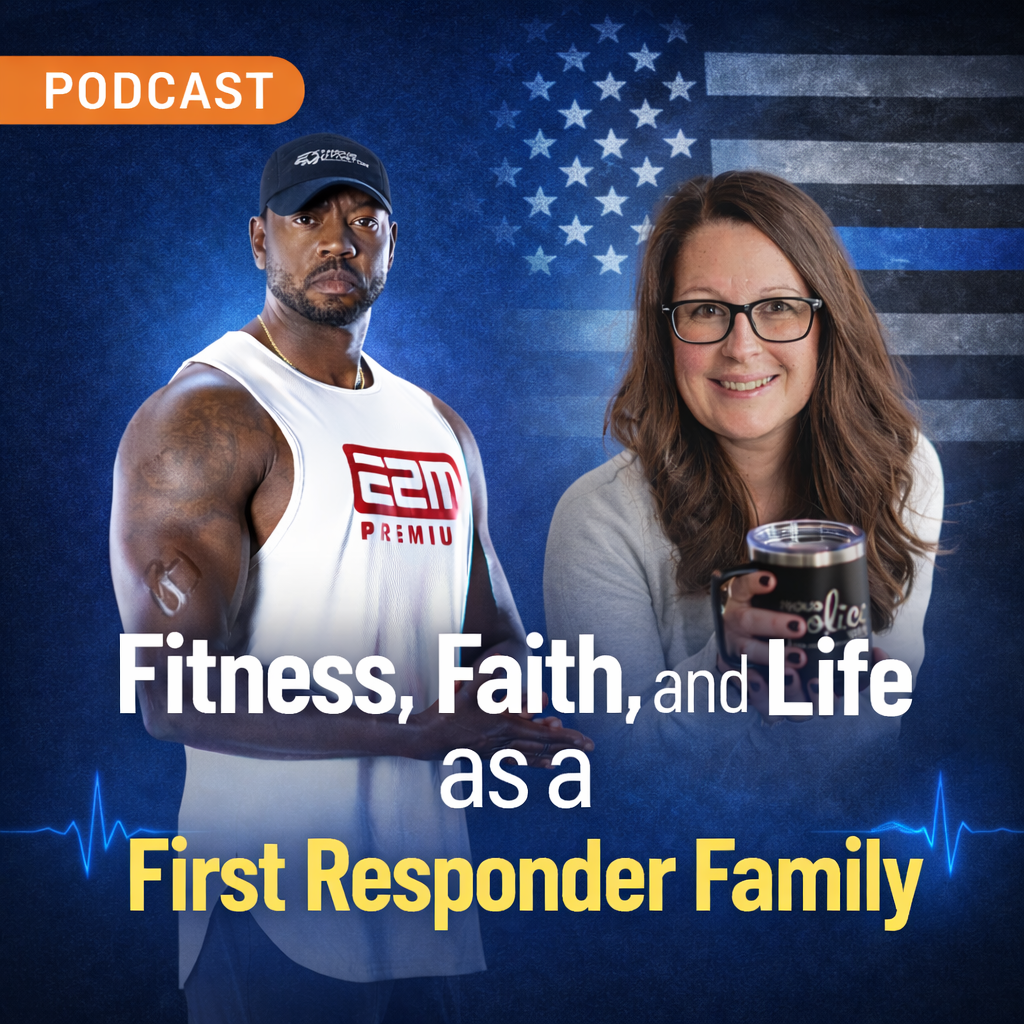
Hey, guys, how's it going? I am Jeff from E2M Fitness and E2M Premium. I am always excited to be able to interview people that I find fascinating. And I came across somebody that I find to be fascinating that kind of has the same passion that I do. So today I get the pleasure to interview Rebecca Lynn from Proud Police Wives. I'm super excited to have you, Rebecca. How you doing?
[00:00:28] Speaker B: Hey, I'm great. How are you? Thank you so much for having me.
[00:00:31] Speaker A: Yeah, yeah, I'm, I'm blessed. And so I know all about your book. I got to dive into it and kind of hear about your story.
Some friends I have a lot. So I am a 21 year military vet.
And so serving in all different levels of command while in the military, the families and the military spouses was always one of the main priorities because, you know, in what my line of work, we deployed a lot. And when you deploy or, you know, you have a situation where you have a police officer on the beat out there on shift, you know, you're leaving your family behind for that time. And, and it's always a nerve wracking scenario, whether it be a deployment for a few months or a normal daily shift for a police officer. So if you don't mind, I'll go into some questions and kind of let all of us learn some of the things that I've learned about you so I can put it into a. Put it into a package that flows a little bit better than me rambling off to you.
Yeah. My first question is, can you share a little bit about your background and what led you to create the amazing group Proud Police Wife?
[00:01:34] Speaker B: Sure. Well, first chef, let me just say thank you for your service.
[00:01:38] Speaker A: Yeah, you're welcome.
[00:01:39] Speaker B: You so much and, and your family as a whole, because we, when it's not just the, the service member that serves, it's the whole family too. And I know a lot of police families, you know, feel that way as well. And so kind of what started my background was actually in education.
My husband and I are high school sweethearts. And yeah, so he's been in law enforcement for over 20 years.
But what kind of prompted Proud Police Wife was.
We saw what our relationship was kind of like, you know, obviously before he went into law enforcement. And then the changes went through with the academy and then field training and then being a rookie, and it was just different seasons of our life. And so not to say that any of that was bad, but we hit challenges along the way. Just like, okay, is it normal that we are now going three or four days without having a full blown conversation, you know, Right. Like entering those waters, like completely new, not knowing.
So again, my background was education and I, you know, I taught kindergarten and first grade for a number of years. After our second daughter was born, we decided that I was just going to stay home for a little bit.
But I always had it on my heart to serve first responder police families in some way. It always bothered me that I remember like when my husband first went in, I would Google like, you know, support for police spouses and there was literally nothing like 20 years ago, there was nothing out there except a couple negative, you know, you know, wrong statistics, you know, weren't even things about police and police marriages. And so it always bothered me. So once I started staying home, I'm not very good at sitting still. I'm kind of, I like being creative, you both.
So after a few months I was like, you know what? Like I like to write.
Writing was a mine that had just kind of gone on the back burner just being a mom and a teacher. And so I was like, you know what, I'm going to start a website. And I called it Proud Police Wife. And I, I kind of went to my husband and I was like, look, are you okay if I kind of share about our experiences, like you know, the good, bad, the ugly. And we had, you know, boundaries and rules as to like, you know, I wasn't going to share our kids online or you know, specifics, but I'm like, I just want to share a little bit about what we're experiencing and that I want other people to know that it's not all bad, you know, despite the things that we're seeing out there, that there's things that can be difficult. But here's what helped us. And not that we were experts in any way, but I just wanted people to not feel alone.
And so needless to say, that kind of, and I don't like to like use this, I use this loosely, but it kind of blew up like it within like two months.
This was now like I was so engrossed in it, which was a huge blessing. I never went back to teaching and it kind of, it became my full time job. And so it started with the website and then you know, filtered into like, you know, social media, a book, a conference. I'll go into all those things I think, you know, as we're talking. But I just wanted it to be kind of a, a safe place for spouses and families to come to get just the horses and support that I felt like you couldn't find other places.
[00:05:11] Speaker A: Yeah, no, I love it. One thing that I pride myself on, having a veteran owned company. A lot of police officers are veterans.
[00:05:20] Speaker B: Yes.
[00:05:21] Speaker A: And so on my, in my online, you know, client base and I own a gym as well here in Monroe, North Carolina.
A lot of people that go to my gym are actual police officers. I have a lot of them. And so I get to, I get to experience some of the things that you're talking about because not only are they balancing trying to have family life and their shifts, but trying to stay in shape as well, which is a big deal. So whenever I see one of my guys come in and he's in his uniform and he's trying to run to the bathroom, the chains get a quick workout in to get back home to the family. It's always like, man, I respect what you're doing. I get it. I've been there. So I know how that goes. Okay, so you kind of told us a little bit about the community. So I'm curious to get your feedback on how the stress of the job, you know, how that, how does that impact the family? Because a lot of people, of course we support the military, support law enforcement, first responders. We really don't hear about the impact on the family. I know first and foremost from the military, but can you speak on that from the, you know, police officer standpoint?
[00:06:23] Speaker B: Yeah. So thank you for asking that. I think it's really important that we've kind of seen this shift in recent years as far as like more wellness for police officers and support for the officer, like in departments and things like that, which is incredible and we so need that.
But I think just an underserved group is the spouse and the family because we are the number one person. Typically if something is wrong with the officer or just, you know, just they're struggling or stressed from work, we're the ones at home, they're going to notice that. And so we have to provide that support. And not only that is when our spouses are out working and we're adjusting to the impacts of the job ourselves. Like I had mentioned earlier about not being able to talk sometimes for three or four days or maybe you went your whole life being able to do certain traditions and holidays on a regular schedule and. And now you can't do that. And while some people adjust to that well, there's other people that it's difficult because their families still want to have holidays the normal way. And you can Kind of feel pulled in different directions. And so, you know, a lot of times, you know, it can range just from emotional, you know, mental impact to just kind of everyday things or, you know, stress and fear of the job, especially during, you know, certain, you know, things that are going on in the world. When you see those things on the news and on social media, that has an impact on. On you, too.
And tricky to navigate, right? Like, you don't want to always share those feelings with your spouse because you don't want to worry them because now they're going out into the world, and you don't want to burden them with those feelings and make them think, oh, I need to worry about what, you know, how my wife is feeling at home, or so it can be tricky to navigate that. And I think what's hard, too, is it's hard to find people that are walking similar shoes as you. And so what makes, you know, proud police wife kind of, you know, unique is that this is a space where spouses can come together, families can come together, and other people understand, you know, what you're going through. And we can talk about those things. Like, hey, that's actually not crazy. I go through that too, type of thing, because we do see the impact of the job on the family. And the more that we talk about it and the more we help the family, the more it helps the officer, too.
[00:08:51] Speaker A: I love that having the right support group, the right community around you, man, is such a game changer for so many people. I see that by putting fitness clients together, and you've seen that by putting police wives together. So having that support group of people that understand what you're going through can definitely be a game changer. So I'll throw a little pitch out there. You know, right now, if you are a police wife out there and you. You want to know more, we'll make sure that you get all of the information about what Rebecca does at the end. But stay tuned because I don't want you to miss that. The next thing I'm. Next thing I kind of want to talk about is I'm also an advocate for using health and wellness for stress management.
I've used it myself for many years for deployments, for command opportunities. Like everything that I've had high stress involved in, I make sure that I stay healthy and I keep my wellness up. At what point did you realize that as a police wife, we're dealing with the stressors of, you know, what your husband was doing on a daily. On a daily basis? At what point did you realize that health and wellness would be a game changer for you?
[00:09:55] Speaker B: Honestly, I'm ashamed to say I think it took me too long to realize that that aspect was kind of on the back burner for me for way too long.
We now have three kids and it was after our third kid where I was like, I'm not able to do anything for myself as far as, like, you know, make the meals that I, that I want to make. I felt like I was eating kid leftovers. And like, especially when your spouse isn't home, you know, and they're working, you're like, let me just make meals for the kids. Or I feel like it took me too long.
But within the last five years, that has completely changed for my husband and I both because we both were like, this is a problem and this is something we both really need. And we made one drastic change, which was four years ago, we sold our house, which was like closer to the city, and we moved out to property and we have 18 acres.
[00:10:46] Speaker A: Oh, wow.
[00:10:47] Speaker B: We need a space to walk and be outside and we wanted our kids outside. But for us being able to, you know, walk and exercise outside side or just have that privacy and not feel like, I mean, my poor husband would try to walk in a neighborhood and everyone's asking him about work, you know, so he couldn't really like, truly emerge. I feel like in, in health and wellness the way that he wanted to and the way that he needed to and sometimes that happens at odd hours for him. So if he's walking at night, it's not some, you know, schedule and that.
So it's been a huge change for us in the last five years. Like, for me personally, I have to start my day with exercising and like. So on the E2M premium app, I love the 15 minute workouts.
And Nanette, I love.
[00:11:45] Speaker A: Yeah, yeah, I love, I love them too. I will jump in on that because you gave me. You set me up for my next question.
[00:11:54] Speaker B: Oh, okay, perfect.
[00:11:56] Speaker A: What I do is I try to help people solve their most challenging problems. And one of the most challenging problems for most people when it comes to their fitness is finding the time. And so most of my workouts are 15 and 20 minutes long.
So I'm solving the problem of busy moms, busy dads, busy people in general, corporate people, et cetera, trying to find a time to fit in their own personal wellness. What do you think are some of the biggest challenges when it comes to police wives and trying to figure out how to fit in their health and wellness?
[00:12:29] Speaker B: Honestly, and I feel like this answers for everybody, but I really feel like it's the phone. I think we're too connected to our phones. Like, if I think we can all probably say we're scrolling for 15 minutes a day, like, could we swap that? Put the phone down and 15 minute exercise. I do. But I will say I know for myself as a busy mom of three, business owner, I homeschool two out of three of our kids, my husband's schedule, it's. You feel so pulled in so many different directions that it feels like sometimes your, you know, health and wellness has to be last.
And one thing that I've shared very openly, like on Instagram, is that I'm trying to find ways to make that work. Does it always look pretty? No.
[00:13:15] Speaker A: Sometimes not about being perfect? Yep.
[00:13:17] Speaker B: Sometimes, like, I do a lot of meal planning and so and I count macros and things like that. But when I'm making. I shared a couple days ago I was trying to, you know, do meal plans. Did I get interrupted 13 times? Yes. You know, so I think, you know, sometimes it's this illusion that, yes, you know, oh, that person's got it together and can fit it in.
You know, sometimes what helps me the most is waking up before the rest of my house because I know that that's my time to kind of get it in. And 15 minutes, like, I can do 15 minutes. And I used to think that I couldn't, but when I kind of prioritized what, what was happening.
The other thing that I've learned too is just now, like, I have, you know, kids that are not elementary ones. Elementary, two are middle school. But now that I am doing those things, they are prioritizing things differently to
[00:14:13] Speaker A: their, their Rebecca, I got to jump in on that one too, because, man, I've helped so many clients with this. You talked about two things that I want to highlight. The one is trading out your scrolling time for fitness.
[00:14:28] Speaker B: Yeah.
[00:14:29] Speaker A: I started clocking how much time I would spend when I wake up scrolling on Instagram or TikTok or social media in general. And I was like, man, I just spent 20 minutes here. If I would have got up and got my day going, I could have ran a mile or two, two miles, three miles in the time I was sitting here learning about what's going on across the world. And so a lot of times it's not that you don't have the time. It's a trade off for the time. You may have to trade off your social media time when you can get up and Knock out a short, quick workout that's effective. And then later on in the day, if you're just hanging out with the kids and you want to use some of that freehand time to scroll, that's a great trade off. Trade off, the trade off, the scrolling for when you are tired and the workout for when you're not. But you brought up a great point on that because if you get up in the morning and like, like how you do you do it, you're a living proof of it. You get up in the morning while the kids are still down, knock out your 15, 20 minutes, workouts done, you can go on about the day. I love that.
[00:15:28] Speaker B: Okay, thank you.
One more thing too is I know I feel like the hardest stage for me and a lot of other, you know, spouses can just be when our kids are really little and, you know, their, their needs have to be met right away. And so one of the things that really helped me when our kids were like babies is just having a gym membership that had childcare. And it is not selfish to do that. Put them in there, they are thrilled to go and do what you need to do. Sometimes I would, you know, like, do a quick workout or whatever, and then I would sit down for 10, 15 minutes by myself, you know, and that's okay too. But to feel that you're, you know, filling yourself up. I know for me, one, I am so much more energized throughout the day because I was so tired, so tired before. I get so more energized throughout the day. If I took care of me first, I, you know, I've worked out. And then I also just feel so much more productive. I'm not thinking like, I haven't done anything for myself today. I haven't taken care of myself today. But now, you know, I do feel like I do that because I dedicated 15, 20 minutes to me first.
[00:16:45] Speaker A: I love it. And to say it publicly, I'm proud of you, Rebecca. Good job.
[00:16:50] Speaker B: Yeah, thank you. I appreciate a long time to get there.
You know, it's definitely the past, like two, three years we've, you know, like. And I will say too, it helps having a supportive partner very much sees the need for me to need to do that, and then I see the need for him to do that.
So sometimes it means like, you know, the kids will want to, you know, tag along on a walk, which is great. But there's other times where, you know, it's not really productive. So I'll say, let dad go have his 30 minutes and then join. So, you know, just having those conversations, I think with your spouses too, to see what they need and backing them up.
[00:17:31] Speaker A: It's a good point. I gotta talk about these books because you're an accomplished author.
[00:17:37] Speaker B: Yeah.
[00:17:37] Speaker A: As a, as a person that's written some cookbooks with my team and all that kind of stuff, man, I had a whole team of folks helping me write those books. I couldn't even imagine the challenge of writing them on your own. So I want to talk about the books because I'm, I'm really, I'm really impressed by your, your books and, and the way you deliver your content. So let's talk about that a little bit. So you've written two books. What, what really inspired you to write them and what messages do you want to convey with both of your books when, when a reader purchases them?
[00:18:09] Speaker B: So the first one is called the Peacemaker's Wife and that's more of like a journal for police spouses.
Really what prompted it was I felt like there was nothing out there. Like my audience was literally asking and saying, you know, hey, I'm looking for this and do you know where I can find it? Well, there wasn't one. So I was like, I'm going to make one. So I just wanted them to have a space to like write down thoughts and encouragement, read encouraging, you know, pieces of information about this lifestyle. Again, I just felt like there was so much negativity out there and I just wanted to provide something that was a little bit more positive. And so that's. I. What prompted the first one.
And then that became so successful that I. That was self published. And then my second one, it was because of the first one being so successful, I got a traditionally published, you know, book negotiation like deal. And so the second one is called Proud Police Wife and it's a 90 day, you know, for so faith based because I hope it's okay to say on here, but I'm, you know, I
[00:19:18] Speaker A: like how you tie the Bible scriptures into all of your stuff.
[00:19:21] Speaker B: Yeah.
[00:19:22] Speaker A: Each day has something to focus on. I love that. I'm a, I'm a big devotional guy myself and so, so I have my daily devotional on my phone in my nightstand. So it kind of keeps me locked into the Word. So I like how you tie some scripture into all your stuff. But please continue.
[00:19:37] Speaker B: Yes, thank you. So. Yes. So I wanted them to just have, you know, that prayer practical application, like sharing, you know, real pieces of our lifestyle and what we'll go through, but also have that scripture and know that they are not alone at the end of the day, even though sometimes this lifestyle can feel lonely. We may not have a, you know, a friend that lives next door that is a police spouse too. But we do have our faith. And so I really believe that we can get through this with, with, you know, God by our side. And so I really wanted to allow these spouses to be able to go through something and again, not, not feel alone.
And so that's been really successful as well.
[00:20:22] Speaker A: I love it. Now you, you, you, you do a lot of cool things, and one cool thing that you do is you host a conference. I've also done conferences before and that's no small task either. So you host a conference for police wives. Can you tell us more about this? And, and, you know, how can somebody support or be a part of one of those events?
[00:20:41] Speaker B: Sure. So about.
So eight years ago, we're getting ready to embark on our eighth conference, which is in April.
[00:20:49] Speaker A: Congratulations on that. That's a big deal to keep something going for eight years. Awesome.
[00:20:53] Speaker B: Thank you. And it is, it's definitely the biggest task that I do all year long. It's like six months in the making every year. But I just felt like I was feeling frustrated with the fact that, that the lack of resources for the family. Again, I was seeing that, like my husband would come home and say, oh, we had this awesome speaker come to our department, but you don't get a lot of information like spouses can't attend. And I'm glad they need those resources. But again, there were amazing speakers out there that also talked about the family, but you couldn't access. You either had to pay a ton of money or travel across the United States. Like they just were not very accessible. And so I wanted to create a conference that really took down a lot of those barriers for police spouses. So the conference is 100% virtual and it's across five days. And I bring together 10 culturally competent, kind of sought after speakers from the first responder police world.
Ones that, you know, they go to talks and all these places and charge lots of money, but they graciously donate their time to the conference.
And I ask for, you know, maybe 30 to 60 minutes of their time. It's a short interview, kind of like how we're doing now almost podcast.
And we do 10 of those based off their expertise. I kind of look at each year, you know, what are the needs, kind of what we're, what our spouse is struggling with.
So we base it off of those topics. But the conference is 100% free for generation.
So we have extra passes where you can do, like, add on things, but those are very expensive, like less than $50.
But we have generous sponsors that donate to the conference every year is what allows us to be able to offer that free general admission pass. So they don't have to deal with time off work, they don't have to deal payment, they don't have to deal with travel. They the videos anytime, from anywhere because they're prerecorded. So it's been incredible. And we've had over 30,000 police families join us seven years and then. So I definitely think we will be beyond that for our eighth year. So.
Yes. So thank you. So I will provide you info if you want to share.
[00:23:27] Speaker A: Yeah, yeah, yeah. Oh, we. We definitely want to share because that's really. That's really cool. We did a health conference here in Charlotte, North Carolina, and boy, that took a lot of planning, a lot of work. And so definitely, definitely congrats on successfully doing such a impactful thing for so many years, because I know it is not easy. Is there any specific resources you provide outside of the speakers when you have the conference?
[00:23:54] Speaker B: So I kind of put together like, a compilation of, you know, a lot of the speakers have kind of like their own resources, whether it's, you know, a website or books or things like that. So we have a conference portal, and then all of that is stored inside the conference portal. So any of the resources. We also have, like, a lot of organizations that will share.
There's so many resources now for law enforcement families that people don't know about. So we just kind of load it up. We put it all inside that conference portal and then can look through to see whatever it is that they need. Maybe it's resources for their kids, for their marriage, whether it's counseling, whatever it is, we put it all in there. And then it's a great hub for everyone to kind of look and come together.
We also have a Facebook group so that people can, you know, get together and have that community piece and talk. And a lot of them will say, you know, oh, hey, where are you from? Is there anybody that lives in, you know, Virginia? And they'll comment. So they like to kind of find, you know, people that live near them, too. So it's a great way, great week for them to just connect and get what they need.
[00:25:03] Speaker A: I love it. When is the conference?
[00:25:05] Speaker B: And it's April 20th to.
[00:25:07] Speaker A: All right.
That's awesome. That's awesome. I love it, man. I'm Excited for you. I know it's going to be another great year as you, as you edge towards that 10, 10th year anniversary. I know it's going to come before you know it.
[00:25:20] Speaker B: Yeah.
[00:25:21] Speaker A: So, so my next question to you as we start to wrap things up, thinking about where you were before you created all the things that you created. What, what kind of encouragement or advice would you give? Because you never know who will watch these things. I always tell people you never know who God has planned to stumble across these videos or come across the path of seeing some of our clips or whatnot. So what advice, what encouragement would you give to a police spouse?
[00:25:51] Speaker B: I think first that to know that you truly are not alone. I know that sometimes when you're going through things or you're struggling, it can feel very isolating. It can feel like you're the only one going through that and to know that, you know, that's not the case and, you know, they can definitely, you know, reach out to me on all my accounts. It's proud police wife. I would love to talk with you. I am an open book and I'm, you know, there to support you.
But also, I would also encourage spouses that I feel like sometimes we get so wrapped up in the fact that the job has an impact on us that we lose sight of doing things for ourselves. And so I think it's really, really important that you make sure you have your own hobbies. I know that before we had kids and my husband worked, I would use that time as like me time that was time to pour into myself. That's changed now that we have kids and that dynamic has changed a little bit. But still making sure that you're doing things that you love, that you're not just waiting for them to come home or you're not just so engrossed in their job that you lose your own identity. So it's really important that you take care of yourself.
[00:27:06] Speaker A: No, I love it. That's, that's, that is great advice. I love coming from someone who's done it at a high level for a long time. I hope whoever runs across that information, they take it to heart. Because you are the kind of person that if somebody reaches, we reached out to you, that's, that's a testament. I'm, I'm not a police, I'm not a police wife. But how kind you are with your time.
When my team reached out to you, you were more than happy to share the goodness about what you do. And that's because you have the heart of Giving. And that's, that's, that's, that's always something to celebrate.
My la. My last question that I want to make sure that we don't skip this one. We'll put it in the comments and the captions and all that. But how do people find you? How do you want them to find you? And what things do you want them to find?
[00:27:51] Speaker B: So you can definitely, the best place to go is Instagram. I'm most active over there. So that is Proud P. Wife and. Or you can just type in, honestly, Proud Police Wife online. And it's, it's going to be either like my website, my devotional, you know, there's Facebook, there's Tick Tock. I have a podcast as well called Proud Police Wife.
So everything though is accessible on my website, which is proudpolicewife.com and you can kind of find all those things that you're. That you're looking for. I also have, I do send out emails regularly. Not spammy, but just, you know, regularly for encouragement and have lots of free, like downloads and things like that. So if you're looking for more tangible resources or just like regular encouragement, then you can, you know, check that out on my website too.
[00:28:39] Speaker A: I love it. Rebecca, thank you so much. It's been a pleasure. All right, thank you. I was excited for this one as soon as you agreed to do it. So I knew it was going to be a great interview. If you are a police wife or you know someone that maybe sometimes people don't run across the right resources and they kind of get left out because nobody's helped guide them to where the resources are. So if you have a daughter or a sister or cousin or whoever that may be a police wife, please share this information.
If you don't share the whole podcast, at least share Rebecca's information because that's great resources that they can utilize and learn and benefit from. And not only that, it's just being connected with that support group and all the things that she provides to her community. So I appreciate you guys tuning in as always. It's always fun to get to talk to really cool, interesting people. May God continue to bless you and I'll see you next time. Peace.