Episode Transcript
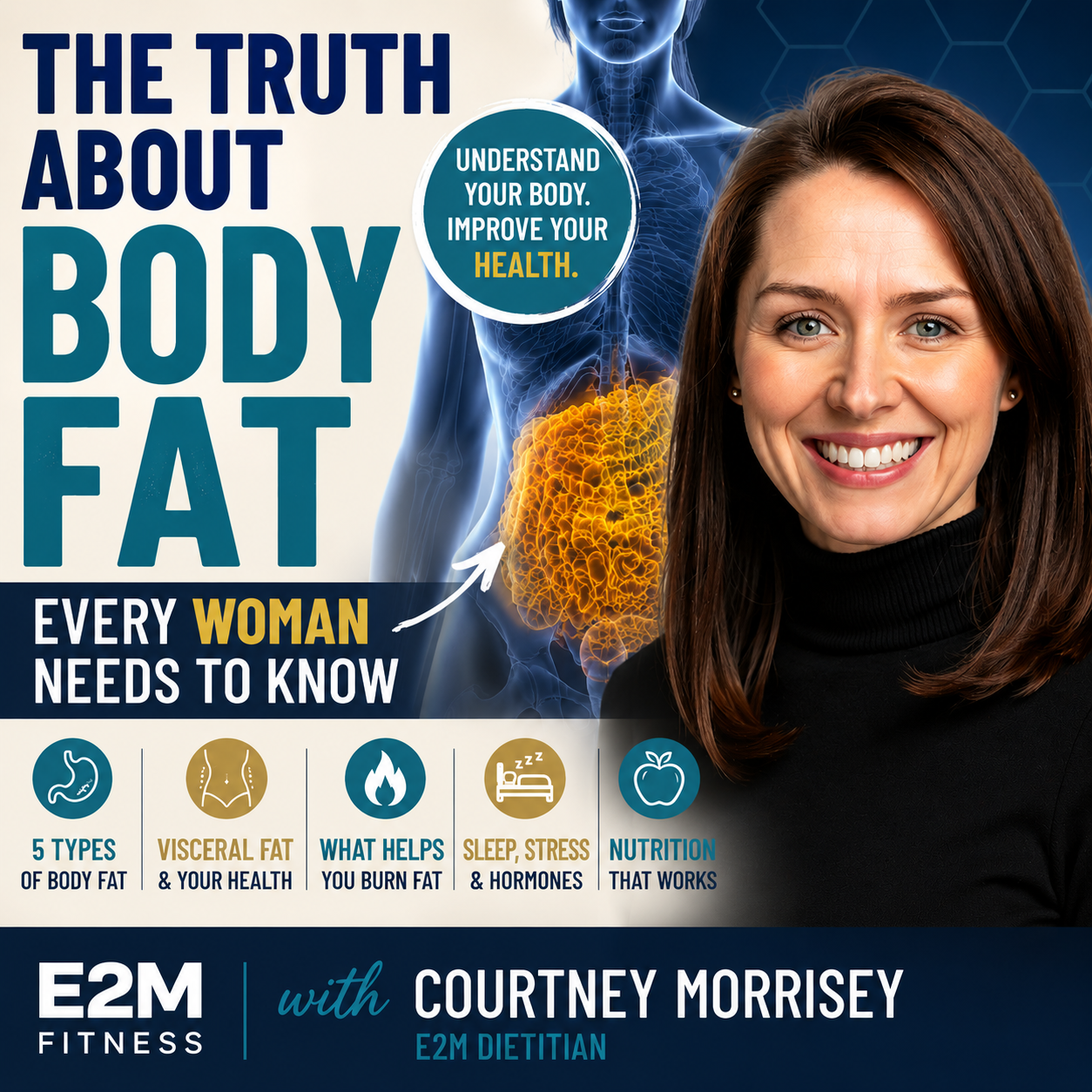
[00:00:00] Hi everyone, I'm Courtney. I'm your dietitian with E2M and today I'm going to talk about your body fat. The different types of body fats we have and then the good, the bad, the ugly of them all and kind of like body composition.
[00:00:16] Now in the past I've talked on your dietary fats, how fats are used within our body, structurally energy wise. But I don't think I've ever talked on your body composition fats.
[00:00:30] So hopefully this information is really helpful for some of you, especially those of you that may have had a body scan or a DEXA scan that's actually showing the percentages of fats that you have in your body.
[00:00:42] Now first things first, everybody's body stores fat a little differently. Specifically, males tend to store fat in their belly or abdomen region and this is more so going to be visceral type fat. Whereas females store fat in their hips, their buttocks and their thighs, which is more so your subcutaneous type fats.
[00:01:06] Your fat storage is also influenced by genetics and hormones. So those do play a role in where your fat is stored as well.
[00:01:14] Now when we talk about the different types of fats, there are about five.
[00:01:18] So the first one is going to be your white fat. Now your white fat tends to be one of the ones that we think about all the time. And, and it's the fat that is intended for energy, it's an energy source for us. So when our body uses all of our glucose, all of our glycogen, it's going to jump to that next form of energy which would be that white fat.
[00:01:39] Your white fat is responsible for releasing some hormones.
[00:01:43] So your leptin, which is your fullness hormone, insulin, which controls blood sugars, cortisol, which is our stress hormone, estrogen, which is a feed female reproductive hormone, and your growth hormones are all tied to this white fat. So it's going to help us regulate metabolism, regulate our hunger, regulate our energy, regulate our reproductive system.
[00:02:11] So white fat is really important just for our normal daily function.
[00:02:16] It's necessary, or excuse me, in excess.
[00:02:20] So when white fat, when we have too much white fat, we do tend to see obesity. Diabetes, coronary artery disease, stroke and hypertension tend to be other health conditions that we see with an excess amount of white fat.
[00:02:35] The second type is brown fat.
[00:02:38] Brown fat is more prevalent in infants and younger children than it is adults. So as we age that brown fat content in our body decreases.
[00:02:48] What's interesting about brown fat, it is it generates a lot of heat when burning Calories.
[00:02:55] So it's a good fat to have when we're trying to lose weight, when we're trying to burn off fat fat.
[00:03:01] So it's one of those things that we also need to help with or protect us from the cold.
[00:03:08] So when babies are born, they tend to have more brown fat because their bodies don't regulate temperature as easily as an older child or an older or an adult's body can.
[00:03:21] Beige fat is going to be the third type of fat. Now beige, beige fat, excuse me, is a combination of your white fat and your brown fat.
[00:03:32] So it's kind of a hybrid of the two.
[00:03:35] So under certain conditions like exercise and cold exposure, it can be more like your brown fat.
[00:03:44] So that's really interesting about the, about the beige fat, but it is primarily found in your white fat areas.
[00:03:52] And that white fat is kind of found everywhere throughout the body.
[00:03:57] The third type is called essential fat. And hopefully like with the word essential in it, you kind of get an idea that it is needed. So essential fat is necessary for survival. We need it for hormone regulation, fertility, vitamin absorption, so A, D, E and K vitamins, temperature regulation, cell structure and function, and then central nervous system functioning.
[00:04:22] So the essential fat is something we have to have in order to function just on a daily basis.
[00:04:29] And then moving forward, subcutaneous fat, some of you may be more familiar with this. This is the most abundant type of fat within our body.
[00:04:38] It is, excuse me, right underneath our skin.
[00:04:42] It contains a mixture of your white, your brown and your beige fat cells.
[00:04:49] And it serves as our long term energy source, kind of like your white fat.
[00:04:54] It serves as a thermal temperature regulator like your brown fat.
[00:05:02] And it also cushions our muscles, it cushions our bones and organs from injury.
[00:05:08] So it plays a lot of important purposes.
[00:05:11] Now with high amounts of, of subcutaneous fat, kind of like white fat, it's going to cause some health concerns or health risks. We do tend to see cellulitis with more white fat.
[00:05:25] We see obesity, we could see diabetes.
[00:05:29] A lot of the same health conditions with an increase of white fat could occur with subcutaneous fat. Too much subcutaneous fat, visceral fat is going to be the last type of fat. I'm going to talk on now. Visceral fat is kind of a dangerous type fat. It's one of the, it's also known as belly fat. And it's one of the ones that we are really concerned about when individuals had a high amount of visceral fat. And that is because it ends up being found in our midsection in our stomach area. And it kind of grows around our organs. So our liver and our stomach and our pancreas and you know, our kidneys and bladder, those organs right there in our abdomen.
[00:06:14] So it's dangerous because it is metabolically active.
[00:06:19] Some even consider it to behave like an endocrine organ or an endocrine system.
[00:06:25] This type of visceral fat, it can affect our blood sugars, causing more insulin resistance.
[00:06:34] It can affect our metabolism, so slowing our metabolism down.
[00:06:39] Visceral fat has also been found to increase inflammatory cytokines, so it can cause more inflammation locally and systemically throughout the body.
[00:06:50] We do see with high amounts of visceral fat or increased visceral fat, higher blood pressure, higher cholesterol, higher blood sugars, kidney disease, stroke, cardiovascular disease and certain types of cancer.
[00:07:05] So visceral fat is kind of like a really bad one that we want to make sure that we are trying to limit as much as we can.
[00:07:12] So fat accumulation is typically driven by our calorie intake, but we also see fat accumulation occur with poor sleep.
[00:07:25] We see it occur with increased stress and sedentary behaviors.
[00:07:30] So there are lots of things we can do to help reduce our fat accumulation.
[00:07:36] And that's what I'm going to talk on next.
[00:07:39] So when we talk about how do we manage our fat, how do we manage this, we do want to make sure we're focusing, excuse me, on a balanced, healthy diet. We want to make sure we are including plant based types of fats that are heart healthy, that are low inflammatory.
[00:07:59] So avocado oil, nuts, peanut butters, nut butters seeds, olives, olive oil, chia seeds. Also your fatty fish, those fatty fish are going to be full of omega 3 fatty acids which help to reduce inflammation within the body.
[00:08:20] Other things with our diet is making sure we're limiting, actually avoiding trans fats. We want to make sure we are avoiding and limiting ultra processed foods. We also want to make sure we are avoiding excess saturated fats. Now the saturated fat is your animal fat. It is bad, tight fat that can increase cholesterol numbers and increase inflammation within the body. And then trans fats are super bad. They increase bad cholesterol, decrease good cholesterol, and they're man made fats. These are less commonly found in our food system. Now since the FDA passed a rule that we're not supposed to be using these in our food system, but I always recommend people reading for them. And trans fats are still listed on the nutrition fact label, so it's something to look out for.
[00:09:12] Now, specifically if you want to get into numbers, we want to make sure we're keeping our total calories of fat to be 20 to 30% of our total calories saturated fat. We generally want to look for 7 to 10% of our calories and then avoiding those trans fats. So zero trans fats.
[00:09:32] Other things that can be really helpful to help reduce the fat accumulation is trying to consume a predominantly plant based diet. Now that doesn't mean that you have to go vegetarian or you have to go vegan, but being really intentional about having more plant options rather than just meat options, especially for proteins.
[00:09:57] So maybe we set a goal of having three days a week, it's fully plant days.
[00:10:03] And that could be kind of a way to jump into a plant style diet of eating exercises to super important when it comes to reducing our fat accumulation, specifically cardiovascular exercising.
[00:10:17] And then we also want to make sure we're including strength training in that's going to help improve muscle. And when we have muscle, more muscle mass helps us to burn more fat mass.
[00:10:29] Prioritizing sleep, it's a biggie for a lot of us. And I think it's one of those things that we don't think about as important for our health and well being and weight loss journeys or health journeys.
[00:10:45] But sleep disruption can affect our cortisol, our insulin, our leptin, which is our fullness hormone, our ghrelin, which is our hunger hormone.
[00:10:57] It can negatively impact these things causing an increase of visceral fat can accumulation by about 11% compared to somebody who gets adequate sleep.
[00:11:08] Now our goals for sleep are going to be about seven to nine hours at night for adults for optimal health.
[00:11:18] Lastly is stress management. This might be the hardest one of all. We all work, we all live daily busy lives with family and friends and social media lives. And we want to make sure we're taking time for ourselves, that we are prioritizing our mental health, being mindful about our stress levels, doing things that can help minimize our stress. So whether it be going for a walk or getting an exercise when you're feeling that stress increase, doing some yoga or some stretching and intentional breathing when your stress increases, counseling and therapy. I cannot recommend enough for stress management.
[00:12:03] So there are lots of ways that we can kind of work through those things. And with our E2M clients we do have our mental health coaches that kind of go through these stress relieving techniques with each of you as well. So I would say let's utilize those, those stress management techniques that are offered now. Altogether, body fat is not inherently bad. However there are some bad effects when we do when we have it in excess I should say.
[00:12:36] So we want to make sure that you're doing the things that promote less fat accumulation, more muscle building if at all possible but also other things understanding the role of these types of fats because there are some that are really good for us, the essential fats we need, our body can't function without it. The subcutaneous fat our body needs for temperature regulation and cushioning and all these other things that they play a role in it's not just bad it's just bad in excess.
[00:13:10] So I hope this information is helpful especially those of you that may have had a skin scan or going to have a body scan to kind of look through your numbers to see where you need to be and specifically what you may need to work on in the future to try and reduce some of your body fat composition.
[00:13:29] And I hope everybody has a wonderful day. Thanks guys. Bye bye.