Episode Transcript
[00:00:01] Speaker A: Welcome to.
Hey, what's going on, guys? Welcome back to the Eager to Motivate podcast. I'm super, super excited about my guest today.
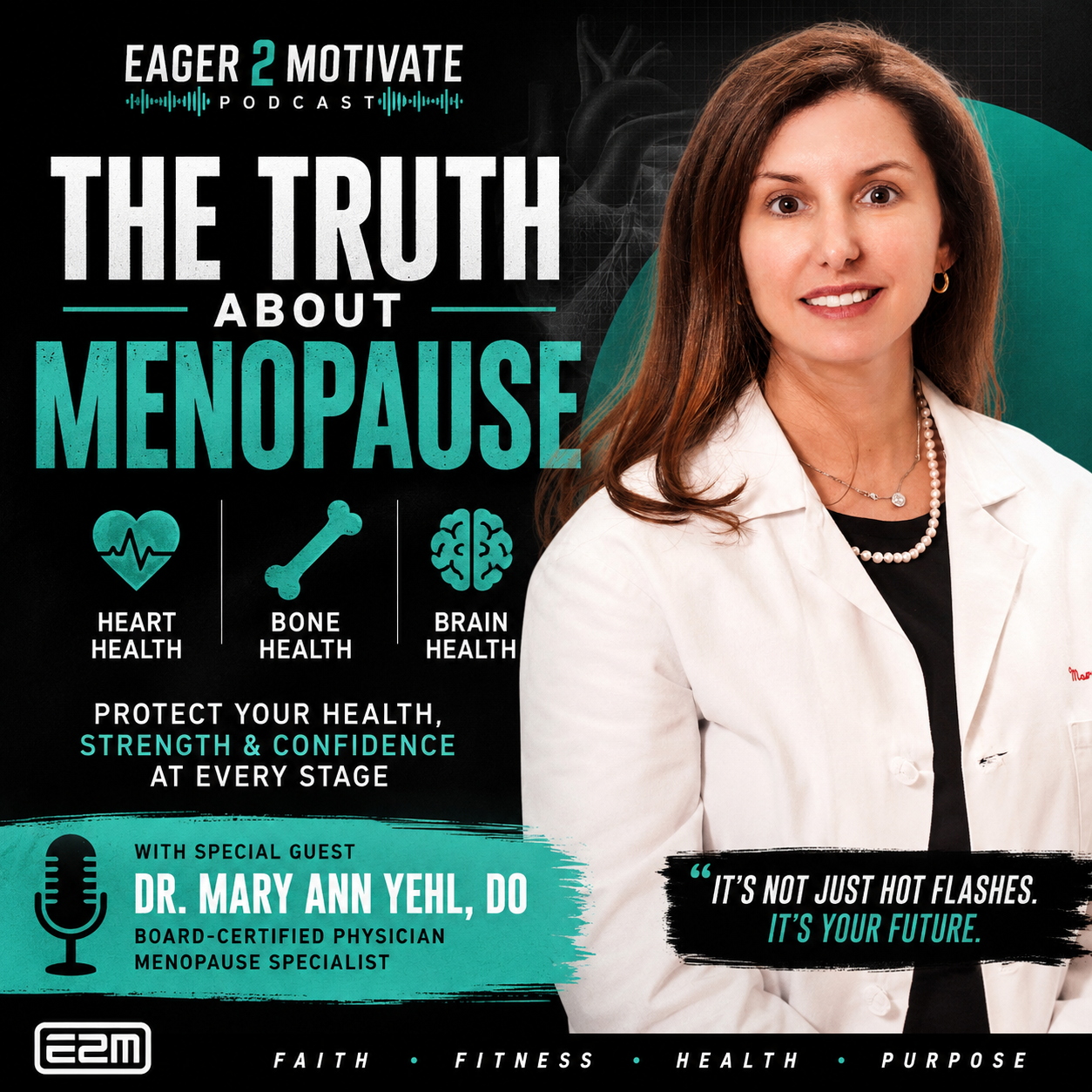
You know, today we're going to talk about a topic that impacts millions of women, but often doesn't get the attention. Attention it deserves. While menopause is usually associated with hormones and hot flashes, it's really about so much more. It's about protecting your long term health. So today I got the professional of the professional. I brought in Dr. Marianne Yell, a board certified physician, Menopause society certified practitioner, nurse, midwife, author and founder of Coastal Women's Medical.
Man, you got all kind of titles, doc. I like that. I like bringing in professionals. All right. Okay. With more than 30. 30 years.
30 years of experience. She's passionate about helping women improve their health span through evidence based medicine, lifestyle, nutrition and movement.
Today we'll discuss heart health, bone health, brain health, muscle health, hormone therapy and sex. Simple lifestyle habits that can help women live longer, be stronger for many, many years. So please help me welcome Dr. Marianne. Yeah, what's going on, doc?
[00:01:30] Speaker B: Thank you so much for having me, Jeff. I'm so excited to be here. This is a topic that I could talk about all day, every day. So I look forward to our chat.
[00:01:39] Speaker A: You know, that's what I want you to do. I want to talk all day, every day. So I hope they're ready for the all day conversation.
So first of all, I want to give you guys a kind of walk into how I, how I heard about and met Dr. Yo. So I was at a conference at William and Mary, my alma mater, where I went to grad school, and one of my, one of my counterparts, we were on a board together and I just brought up the topic of perimenopause and she was like, you gotta talk to my doctor, you gotta talk to my. She changed my life.
I was like, you know how somebody, when they give reviews of things, it's like the level of excitement that they exude tells you how much they like it. Like, her excitement level was on a 10. She was adamant about me talking to Dr. Yell and not only was she adamant about that, she made sure that I did. After the conference, she linked us up, followed up and made sure that we connected. And so trying to get on Dr. Yell's schedule and get on my schedule, we finally made it happen. So I'm super, super excited to have you here. So first of all, doc, I'm going to open up with people who are tuning in. You got to hook people early. So I want them, they heard me talk about you in the intro, but I want you to talk about yourself, which is tough for a lot of us professionals. But I want them to tell you, you know, I want you to tell them, you know, how all these certifications I mentioned earlier, tell them your background so they can know why I brought you here.
[00:03:00] Speaker B: Sure. So I've been in the women's health space for a long time. I started out as a nurse and then went on to be a nurse practitioner and a nurse midwife and then went on to medical school and I decided to do family medicine so I could really combine all of my efforts. And so I've really been in the women's health space since then. I'm certified in menopause, so I kind of have a bridge in my practice of gynecological procedures and care, primary care and menopause care. And I think that those things come together so nicely. And, and because women spend half of their life in perimenopause menopause, I feel like it's just crucial for us to know and to be able to treat well. Plus I see a lot of younger women who have hormonal issues.
And I'm also a high school doc, so for an all girls school. So that's super fun.
[00:03:52] Speaker A: I love it, I love it. And you know, I don't want to gloss over the years of experience because you've put a lot of time into the medical field.
What made you decide to focus and kind of hone in on the menopause aspect?
[00:04:07] Speaker B: So it was really a personal thing. I was going through these changes myself. I had seen patients in this space and I felt like just with my own care and with my patients care, that I was missing the mark. And as I was going to people, my primary care, my GYN endocrinology, nobody had a good answer. And I thought, wait a minute, I have to dig in here. And unfortunately, menopause and perimenopause isn't something that really you learn about. It's something that you have to go chase after.
And so I was able to do that. And all of a sudden I had this flock of patients, you know, coming to me saying, oh my goodness, nobody knows about this and we're all suffering so you know, help us. And myself feeling so much better. It just became just my passion.
[00:04:55] Speaker A: I love that, you know, and I mean I, I was talking to somebody the other day, it's like when you have something that you're personally passionate about, you're going to do so Much better in delivering it to other people and helping somebody else with it because you're personally passionate about it. So hearing that, you know, you personally wanted to solve or look after the issue for yourself, I understand why you're so good. So I do have another question about that. So I have some questions here, but I'm, I'm going to kind of dig into that one a little bit deeper. Why do you. Why do you think it's so much information online about perimenopause and menopause and podcasts and that kind of stuff, but not as much medical support? If I go to my doctor, why am I not getting the correct answer or the simplified answer? Because I may go to my doctor and my doctor may tell me to do this. And then I turn on my Instagram and I got, you know, four or five people on podcast saying to do this and no, don't do that, do this, or don't do that, do this. So why do you feel like there's such conflicting dialogues out there?
[00:05:57] Speaker B: It's a really good question. So really it stems from the fact that there was a study many years ago called the Women's Health Initiative Study. And not to get into the details, but it wasn't really a great study. And it gave a lot of misconceptions about some of the treatments and menopause. And so a lot of the docs, when this study came out in 2002 and we had a black box warning that went on hormone therapy, just said, oh, forget it, I'm never going to prescribe it again.
Now those of us who are prescribing it at the time were like, geez, that doesn't seem right. That's not what we see clinically.
But so many doctors shied away from it and kind of never looked back. Now luckily last year, the black box warning was lifted because it just didn't have good evidence.
And so doctors started to prescribe just a tiny bit more freely. But again, this really isn't something that we learn about in residency. So as a doctor, you know, when you're prescribing, you're seeing patients. These are prescription medicines typically that we're giving. You know, you're. There's no profit to be made per se versus, like if you're, you know, selling a supplement on Instagram, that's very different. And I feel like a lot of people have tuned into the perimenopause menopause space as sort of like a cash, cash out for all different kinds of things. And I have Patients that come to me, I mean, I'm usually not the first stop. And when they come to me, they're like, I've been here, I've tried this, I've tried these supplements. I've, you know, done all these crazy things. I've held my head underwater. I've taken seven supplements. You know, I've done these ice challenges. And you're like, oh, my gosh, what is going on?
[00:07:37] Speaker A: It gets people to click on podcast document. It does.
I'm telling you, when people click on this podcast, I want them to get real information from a super highly certified person. But, I mean, you put somebody with a podcast mic, you're getting some clicks, you're getting some views. The more sensationalized it is. Do this extreme thing. Oh, wow, is that the. Because you have these ladies, Doc. And like I said, I'm going to stick on this one. You have these ladies who are looking for a solution. They're looking for something to help them. And so if I tell you, go do this radical thing. Well, maybe, maybe if I try that, that will help me. Is that kind of what you're saying, too, when folks come into you?
[00:08:13] Speaker B: Absolutely. So I see that women feel so crummy that they're like, I will do anything. You want me to do a bowel cleanse and only eat prunes for 10 days, I'll do it. If that's what you think is going to help. And you feel so bad because these women are just suffering and they don't have to be.
[00:08:32] Speaker A: Yeah. And so. So let's. Let's talk. Let's talk about. Because you really focus and just hearing your background, you focus so much on the overall health span of a woman. You focus on the cardiac health, bone health, brain health, menopause. You focus on all of that stuff. So kind of thinking about a holistic concept. What is the most underrated issue that women that. That keep women from living longer and healthier?
[00:08:57] Speaker B: So I think two big issues really get missed in, really in midlife and in early life. So we're talking 20s, 30s and 40s and 50s, and that's really cardiac health and bone health.
And, you know, we see women who often don't even have a primary care doc, Right. They go to urgent care, they're busy moms, they're taking care of everybody.
They get their pap smears once a year and maybe a mammogram, and they think, I'm good, I don't need to do anything else.
But there's a huge opportunity there. And also Times they're, you know, they're doing exercise, but they're doing exercise to fit in their genes, not really for longevity. And that's a big difference. I mean, you know, you're in this space. Oh, yeah, it's, it's definitely a different outcome when you're going for longevity. And so by the time women come to me, I'm very blessed that they're motivated. They're typically wanting to get healthy. And so one of the first things that I do is really assess cardiovascular health. So a woman should have a primary care doctor really at every stage.
And this should be the quarterback. They should be checking things like your cholesterol, your blood pressure, looking at your hip to waist ratio, not just your weight. I mean, weight is really underrated. I mean, we see a lot of people, a lot of women especially, who have these tiny little arms and legs and big bellies. So they're kind of full of visceral fat, which is really bad metabolically.
So really getting a good assessment. Like I use an in body scale. Lots of people have those.
So it looks at visceral fat and muscle mass so we can track it over time and see how women progress, which is so fun to do.
[00:10:38] Speaker A: Man, Doc, you know, I love when I bring professionals on and they back up things that I say all the time, those happy bellies and the extra, extra stuff around your waist is not just a vanity thing, it's a warning sign.
[00:10:54] Speaker B: You're absolutely right, because visceral fat, which is this fat that surrounds your organs, tends to build up in perimenopause.
And so we start to see these changes. But I think too, you know, any kind of insulin resistant condition, so if you have a patient who has PCOS or PMOs as we call, you know, polycystic ovarian or any kind of condition where they're having insulin resistance, we're going to start to see that visceral fat, which is just so bad. It's very metabolically active and really bad for your heart. So we want to address that. And, and I mean, you know, exercise is one of the most underrated ways to really turn around your cardiovascular health. Between your lipids, your blood pressure, your cholesterol, your bmi, your visceral. All of this comes from hearing it from a doctor.
[00:11:43] Speaker A: You're hearing it from a doctor. I'm a personal trainer, but you're hearing it from a doctor. You hear, oh, caveat. We're not giving out medical advice.
[00:11:51] Speaker B: We're not giving out medical advice.
This is educational, only educational.
[00:11:56] Speaker A: Only. Thank you, doc. Education only. But, hey, so I want to dig in, dig more into the cardiac health. That's a big one for me because my father, you know, ultimately passed away from having multiple strokes. And I'm just. I'm really. People that know me have been around me for a while. Like, I'm really big on getting your heart checked and making sure, you know, your calcium score and all that kind of stuff, making sure, you know what's going on with your heart.
Do you think most women have a good understanding of their heart health?
[00:12:29] Speaker B: Not at all. Not at all. I mean, when I see patients, I see a couple different scenarios. So, like you, I see women who will come to me and they'll say, you know, my dad died early of heart disease. And I'll say, oh, well, when was your last echocardiogram? You know, your ultrasound of your heart? When was your last stress test? When was. And they'll say, well, no one ever told me I should get that.
And I'm going, but you had a parent who died young of heart disease. Why is no one ringing a bell here? Yeah, you know, and so I'm very, very pushy about women getting evaluations for cardiac screening.
[00:13:05] Speaker A: You know, I do want to ask this question. If I'm stepping into, you know, foreign territory, let me know. Doctor, call me back.
But I have so many clients that I talk about my experience because. Because of my father, I'm very diligent about making sure I keep an eye on my own heart. And I'm a healthy guy, but I'm still like, I want to be super healthy because I know what's happened to my father. And so every year, I get a Cleveland heart study done and a carotid artery scan.
And so when I talk about that, people go to their primary care physician or doctor, and they're like, hey, I heard my trainer say that he does this. I want to get this.
And their doctor tells them, you don't need that. So I'm not going to order that for you.
What is some things that. What should somebody do? And like I said, I don't want to conflict doctor's guidance. But if somebody's just trying to get that test done, what should they do? Like, what if their doctor says, you don't need that? Should they just assume that they're good?
What should their next step be? Because this happened a whole lot. A lot of people have gone to their doctors, asked about these tests, ask for more tests for stress tests on their heart. Whatever. Doctors told them, you don't need that. So what. What should they take from that response?
[00:14:18] Speaker B: So I would push back.
I would push back and say, hey, listen, this is why I think I need it. I am overweight. I have a family history. I've had this high cholesterol for a long time, and I can't seem to get it down. Whatever the reason, you. You know, I had a friend who passed away of a sudden heart attack.
And as a physician, I get that, you know, you want to be careful.
If your doctor is really adamant about it, you need a new doctor.
You can certainly go out of network. You know, you can pay for these tests yourself. There's plenty of labs now where you can just do these tests and you can get these.
But if your insurance could cover it, why not go through that?
[00:15:00] Speaker A: Yep. And what I did find out for my area, I can't speak on everywhere across the country, but if you do decide to go pay out of pocket, it's not very expensive. And so.
And that's a relative term, but for what you get in return is relatively inexpensive to have the comfort or clarity of mind to know where your heart and your arteries stand.
Okay, so I won't dig too deeply on that one, Doc, but it was important to me because a lot of people, I talk about heart health so much, and I'm sure you do, too. And people are like, okay, well, besides just working out and eating healthy, which is something that we all need to do, what else can I do to keep an eye on my heart health, to make sure that my heart is healthy? And especially ladies in that perimenopause menopause range with our American diet, you know, you got to know if you're up in age, if you're getting to the perimenopause menopause stage. Yes, you're fighting with the challenges of perimenopause menopause. But it's also other things. Your gut health, your heart, other things you got to be just as concerned with while you're dealing with all the changes of perimenopause and menopause.
[00:16:04] Speaker B: Absolutely. You have to know your numbers. And really, I don't disagree with that. In perimenopause, I also see kids who are 18 and 19 who have high cholesterol.
And so what do we do then? And, you know, a lot of these kids have had it for a while, so I'm really, really invested in heart health, no matter what age, because the idea is that if you have high cholesterol, you know, you have this bad lipid Building up on lining of the blood vessel as it builds up year after year, you know, that can become a problem. So if you have high cholesterol at 19, you can imagine that at 29 or 39, this is. This is a bad situation. So I really like to be aggressive with younger people too, in terms of treating that, assessing it, getting it under control so that it's not an issue later. But knowing your numbers, no matter what age, is incredibly important.
[00:16:57] Speaker A: I do want to, like, one more question on the cardiac health stuff.
You know, there's a lot of stress that comes into play for ladies who are in perimenopause and menopause in multiple different ways. You know, having to be able to have the unregulated hormones and emotions and that kind of stuff. Those things don't just affect you. They end up affecting your spouse, they end up affecting your co workers, whoever. So it brings a little bit of added stress to your life. And so with that added stress, that's also not the greatest thing for your heart health.
So what are your thoughts on, like, chronic stress and elevated cortisol? What are your thoughts on that? About bringing that down to make sure while you're dealing with all the other stuff, you're not also damaging your heart with those high stress levels? High cortisol levels down.
[00:17:51] Speaker B: Absolutely. So, you know, cortisol is not essentially a bad hormone, or at least it wasn't meant to be. Right. Cortisol's job was to wake us up in the morning, get us out of bed, you know, get us moving for the day. You know, in perimenopause, menopause, or in high stress situations, it elevates and it stays elevated, which causes increased fat storage, which we don't want, especially visceral fat. It disrupts our glucose insulin cycle, again, helps us maintain fat, which is not what we want to do.
And that chronic stress just keeps cortisol high and leads to inflammation. All of these things are bad for the heart. And I do get patients who will say, what's my cortisol level? Can you check my cortisol level? I'm so stressed.
My answer to that is, well, then it's high.
If you feel stressed all the time, you have a high cortisol. And if we check it and it's low, we checked it at the wrong time. And the treatment is to manage your stress. So, you know, my feeling is that really in high school, stress management should be a class. It's not, unfortunately.
[00:18:52] Speaker A: Right.
[00:18:52] Speaker B: Because, like, who needs to know how to manage stress we all do. And it doesn't go away. It just changes how it looks in our teens, in our 20s and our 30s and our 40s.
So it's still there. So it's really our response.
[00:19:07] Speaker A: You're hitting it on the money. I tell people all the time, I know a lot of folks don't enjoy making time for a workout. They don't enjoy making time for some cardio, they don't enjoy making time to go walk. But if you learn how to make those things something you can enjoy, find different forms of exercise that you actually enjoy, that could be a great stress reducing activity. Because for me as an entrepreneur managing a whole bunch of stuff, if I don't work out, everybody around me, they know, they know when I have worked out, hey, go, go work out, man. And so I use that as a, a stress reducing activity. For me, if I've had a Busy Day, spent 21 years in the military under combat loads, stress, that kind of stuff, working out kept my mind straight. And we'll talk about mindset, mind, you know, brain health later. But you know, working out really helped in reducing that stress load. And I'm sure, doc, you agree with that.
[00:20:02] Speaker B: Absolutely. Working out is a huge part of stress management. And during my, my visits, in my first visit, I always ask patients, how do you manage stress? And most of them say, I don't know.
And I say, okay, well let's back up. You said you go for walks every day, is that stress management? And they'll say yes. I said, well, you go to Pilates too or you go to your weight training classes, you know, and it always cracks me up because in this stage women will say, well, I try to run.
And they say it like that. And I'm like, okay, you don't have to run.
[00:20:35] Speaker A: Do something you enjoy. Exactly.
[00:20:38] Speaker B: Don't think that that's the answer. It's really about finding something that enjoy so that it decreases, not increases your stress.
[00:20:45] Speaker A: I love it.
[00:20:46] Speaker B: Exercise is one of the best ways
[00:20:48] Speaker A: for it staying on exercise. Doc, I'm gonna go into my next topic here, bone health. And so, you know, for me as a trainer, I focus on ladies in perimenopause, menopause, getting them strong. I have a program called Strong Pause where I focus on strength training for ladies and perimenopause, menopause. Let's talk about how strength training can help with bone health. We're seeing all these podcast out there talking about the benefits of strength training and you know, I help the ladies figure out what that actually means. If you're here on the podcast, you need to strength train. Well, what does that look like? So I got a program for you. I make it easy for you, but I want you to talk about why strength training is so important for that bone health.
[00:21:27] Speaker B: So strength training is really like the foundation of bone health, and we have great data to support that. Strength training not just protects our muscles, but it protects our bones. So. So you increase bone mass when you strength train. And jumping, I also like to do that, but it absolutely increases the density of our bones and our muscles, which help us prevent falls and things like that. So strength training is really the non negotiable in terms of osteoporosis or thinning bone prevention.
So all of my patients, I'm like, you have to strength train two, three days a week, and you have to do it in a really specific way. So many of my patients will say, well, I do strength train. I have these little pink dumbbells by the tv and I lift them up like this every night while I'm watching tv. And I say, no, no, no, no, no, no, no. That is not strength training. It's a very specific kind of strength training. It's progressive overload. Strength training.
[00:22:26] Speaker A: Said the term, I didn't tee you up for that. I didn't tee you up for that.
I didn't throw a baseball signal for her to say progressive overload. She said it on her own. Because a lot of my clients over the years, I've been doing this for a long time, trained a ton of people, and the concept of progressive overload has been been a challenge to a lot of people to understand. Like, you have to challenge yourself with a heavier load over time to get stronger. Your body will adapt. And so my program, Strong Paws, I break it down to the smallest of the smallest comprehension. Like, take this weight. Over eight weeks, we're going to build up strength through reps, higher weight, and by the end of the eight weeks, you should be lifting a lot more than you lift. Day one, week one. And so I think solving the problem of, okay, I got the advice to do this. What does it look like? And that's what I'm really excited about. I mean, these types of podcasts also do that. You hear some information from your doctor or online and you're curious.
Most ladies walk away from an appointment, you know, being, you know, confused about perimenopause, menopause symptoms, and they start to look and research.
And so I'm super happy that, you know, Dr. Yale, that you're able to do this because I want people to find great information and not just click bait, sensationalized stuff, like really good stuff. And so. Okay, we'll jump into my next thing, brain health. Okay, so almost every woman in midlife complains about the brain. Brain fog, right? Forgetting keys, struggling with words.
How do we distinguish between, you know, standard midlife brain fog from long term cognitive decline?
What is the impact of exercise on brain health and dementia? And so I'm going to kind of expand on that conversation.
So a lot of people, when they have a parent, you know, experience dementia.
Scary. Because you're wondering, will that happen to me?
Will what? What can I do to prevent that from happening to me? And so there is things that you can do to fight back against those things happening to you. So, Doc, please.
[00:24:40] Speaker B: So one of the first things that we can do is exercise. We see a decrease by almost 40% in dementia with exercise. Like, how simple is that? So we have people taking these crazy supplements, doing all. Trying to learn Japanese, you know, trying to do all these really complicated things and like just go out and exercise. This is not that hard.
[00:25:04] Speaker A: You said it.
[00:25:05] Speaker B: Yes. I mean, it's really the most underrated. So when we think about, like the whole thing, exercise is one of the most important components. Mediterranean diet, having a really good, healthy diet, making sure if you have diabetes or high blood pressure, you keep that in check.
Having good social connection and community.
Making sure if you have hearing loss or vision loss that you treat it. It's amazing how many people are resistant to that. Just treat it.
You know, if that increases our risk of dementia, which, you know, women have two thirds of the dementia cases. Crazy.
Why would you not do these things? I mean, these are simple, simple things that really are not expensive or difficult to do.
[00:25:49] Speaker A: Exercise can be free.
So. Okay, so, Doc, I do want to jump into one last topic before I get you out of here. And that topic is, I want to be delicate about this one, okay? Because I deal with so many clients that will go in and they will get prescribed a medication, let's say for cholesterol or blood pressure, and they walk out and they, they feel like that is it. Like, okay, I'm going to fix my high cholesterol, I'm going to fix my blood pressure with this pill, and I'm good to go right back to the fast food place, right back to the barbecue, right back to the unhealthy foods I was eating. Because now I got this pill. So I can, I can do, I can do what I was doing. But now I can do it better, safer.
I don't think a lot of people understand that the secondary piece to getting on medication is the lifestyle change.
You have to accompany medication with lifestyle change because if a poor diet and lack of exercise got you to the point to where you need the medication, just getting the medication doesn't solve all problems. It doesn't mean, like, okay, I got this pill, now I don't got to work out. I got this pill, now I don't have to eat healthier. The pill is a bridging thing.
It's to help you help your poor lifestyle choices in health, diet, that kind of stuff, give you enough time to fix those things before you have a heart attack or stroke. And so for me, a lot of people are at that crossroads, especially with health and perimenopause and menopause, between, like, do I get on hormone therapy? And is that just going to be the answer to fix everything?
So I just want to hear you talk a little bit, because people get on podcasts and they'll say, you need to go straight to hormone therapy. But there's a lot more to the story than just jumping on hormones. It's like, it's more to the story. And so I just, I definitely want to hear a medical professional, just for educational purposes, talk about, like, there's more to the story than just the hormones, than just the pills. That's not the end of the story. There's more prescription to be made. But doctor, on you.
[00:28:07] Speaker B: So I love the way you said it's a bridge, because I don't think that many people see those medications, like, your blood pressure is so high that I'm going to give you a medicine so you don't have a stroke. But in the meantime, let's start you on a cardiovascular rehab program. Or, you know, you're very overweight. And I get that that's a problem. So let's give you a GLP and. And have you weight train and have you see a registered dietitian and have kind of all those things come together. It's not like, here's your Lipitor, now you can eat two hot dogs instead of one.
That's not the idea. I mean, the idea that it really is a bridge to just get you to a better spot. And patients are always surprised when they go on a great diet. They exercise, and they say, doc, do you think I can get off of my blood pressure medication now?
Well, yes, sometimes that happens, you know, when we're.
[00:29:04] Speaker A: Or reduce. Or reduce the dosage.
[00:29:07] Speaker B: Exactly, exactly. You know, with medication, it's increased cost, it's increased side effects. You know, it's not. It's not all good. So not to say that medication is not helpful. It most certainly is. But it really should be viewed as a bridge to get you where you need to go.
In the case of someone who has, you know, high blood pressure, who's overweight, who's, you know, not having a great diet, who's not exercising, we really can use it like that. Unfortunately, most people don't see it that way, but it really should be like a whole lifestyle program that we initiate. And, you know, many women come to me and say, like, oh, I've heard HRT is the, you know, is the magic bullet. Was not a magic bullet.
In perimenopause and menopause, estrogen goes down. Estrogen acts like a shield in terms of protecting our brains, our bones, and our heart.
And so anytime it goes down, if it goes down because we have early menopause or we have a hysterectomy, or we're on estrogen sparing medications, we lose that protective effect.
So, yes, exercise and nutrition should be a very big part of that.
And sometimes estrogen has a role.
It definitely can be beneficial in the right population. I think it should always be part of the conversation. No matter what. We should always say, is this something that we should bring in? And sometimes it's not, and sometimes it is. But we know now that starting early gives the biggest benefits. So I love when I get to see women who are 35 who are saying, tell me about estrogen. And I can say, this is the perfect window to have this opportunity because we have some time now before, you know, menopause really sets in.
So I love that.
[00:30:50] Speaker A: No, and I want to back up because I want to make sure people understand I do this for a living. So I have a lot of sympathy in the fact that telling somebody to make a lifestyle change with diet and exercise is easy for somebody like me to say, but I know it's a very challenging thing for a busy mom or a person that's an entrepreneur like me, or a person that's working.
Making time for your health is not always easy, and I'm not going to marginalize it. But I will tell you that what I always talk about and what I try to bring to the table is make sure your health is as important as the other things in your life.
Make it just as important to exercise as it is to take those meetings.
Make it just as important to eat healthy as it is to Watch your favorite TV show. Just make those things equally important or more important in your life. Because when it comes to health, by the time a lot of people get to where they're fearful and they go to Dr. Yale, there was so much you could have done before that. There was so much weight you could have lost before that. There's so many healthy things you could have done before you got to the fear, fear factor level when, like, Dr. Yale, help me, I don't know what to do.
[00:32:12] Speaker B: Right.
[00:32:12] Speaker A: There's so many things you can do before you get there. But we're definitely blessed to have doctors like Dr. Yo who love doing what they do and can help get you back on track. So. So, doc, I will say that was kind of my, my, my rah rah pitch. But I would love for you not only to tell ladies, because a lot of, a lot of my clients and this has happened many times in the past, and I'm thankful that I'm able to bring in people like you because folks that don't feel like they're getting the right answers or looking for the right answer, they want to talk to the person that is on the screen. And so first of all, before I have you close out, I want to make sure they know how to find you. So how can they find you on socials? How can they find you on business things? How can they get a hold of Dr. Marianne Yell?
[00:32:55] Speaker B: Thank you. So the easiest way is through my website, Coastal Women's Medical and located in New Jersey. But I see patients in eight states via telemedicine and Instagram. Dr. Dr. Marianne Yale by HL and we can link it below.
TikTok the same and YouTube very similar. We can link that below. And I also have a guide, you know, because I'm only in eight states, a lot of women will call me from different states and say, how do I. How do I talk to my doctor about this?
So on my website, you know, I can't see everybody, but on my website, I actually created a whole course with a guide on how you can talk to your doctor and how you can get a better understanding of these symptoms and you know, how to interpret your labs, because that can be really confusing. And I'm very blessed that I have so much time with my patients. Not everybody does.
So tried to make the right thing easy.
[00:33:54] Speaker A: Hey, listen, you must have an entrepreneur mind because that's a brilliant thing to do because a lot of people don't know what questions to ask. So please, we'll post her website Dr. Yale's website in the comments here. So if you want to check out that guide, I'm recommending it, endorsing it, whatever you want to call it. I think it's a great thing because if you don't know what to ask, your doctor can only give you the advice based on what you tell them.
So if you don't know the right thing to ask, you may not get the right answers you're looking for. And you could be frustrated because you don't feel like, well, my doctor didn't tell me about that.
Doctors are human. They're human beings. You know, they're not perfect. They're human beings. And so if you ask more prompting questions that you know are kind of supportive to what you're trying to get after, you may find a better answer or get a more thorough response from your doctor instead of just, you don't need that or that's not for you.
So. Hey guys, I do want to give Dr. Yell some closing thoughts. Doc, what would you tell if somebody's watching this and they, they're at the early steps of man, I just feel like crap. I don't know what's going on.
My, my spouse is telling me that I'm, I'm a little bit more moody or whatever it may be.
What would you give them as their, their what, what action should they take from, from that initial feeling of helplessness? What, what, what would you tell them to do educational wise?
The first step they should take educationally?
[00:35:16] Speaker B: I would look at sort of the five things that make us healthy. Right? I would look at exercise. Are you exercising okay? Definitely weight training is the top of that. You know, make sure you're weight training and get some help. I love your program that they break down the videos that actually shows women how to do it so they don't get hurt. Okay, so exercises first. Make sure you're sleeping. Okay. Make sure you're eating really healthy non processed foods. Make sure you have great social connection and manage your stress. So those are the underlying things. If you've done all that and you're really not feeling like yourself, try to find a menopause certified physician to help you go through this. And again, if you don't have one of those locally, I have that guide to kind of help you because there's only about 4,000 of us in the country, not many.
[00:36:09] Speaker A: I like it. And that's, that's, I mean, you know, I think everybody has things that they're looking for from a doctor. And so if you're not finding what you need from the person that's in your area. Shop around, look for somebody else. Don't just throw your hands up and say, well, that doctor didn't help me find somebody else because you know it's beneficial to your health, like Dr. Yell was talking about earlier. Not just to walk around in a state of high frustration and high stress. It's going to damage your heart and you don't want that. Doc, we've gone way over my time conversation based on, based on any kind of feedback we get from our clients and people that watch and viewers. I may have you back again. If they have a whole bunch of follow on questions, I'll have you back in. But I thank you so much for just being willing to do this, taking the time out of your day. Again, I only bring people on here that I think are awesome, that have high levels of certifications. So please go check out Dr. Yale's website.
You know, if you're. Especially if you're in one of the eight states that she's practices in. But Doc, I appreciate you. This has been an amazing time.
I learned. I learned something. I learned a couple things or two myself.
And I'm happy to have you. So closing thoughts go to you.
[00:37:22] Speaker B: Oh, thank you so much for having me. This has been such a pleasure. So for women in this stage, please go see your primary care, assess your bones, assess your heart, and you'll be your healthiest self at 80. Thank you.
[00:37:37] Speaker A: I love it. You guys have a Great, beautiful day. Dr. Yo, you are amazing. Virtual high five to you.
And we'll see you guys next time on the Eager to Motivate podcast.