Episode Transcript
[00:00:02] Speaker A: Welcome to.
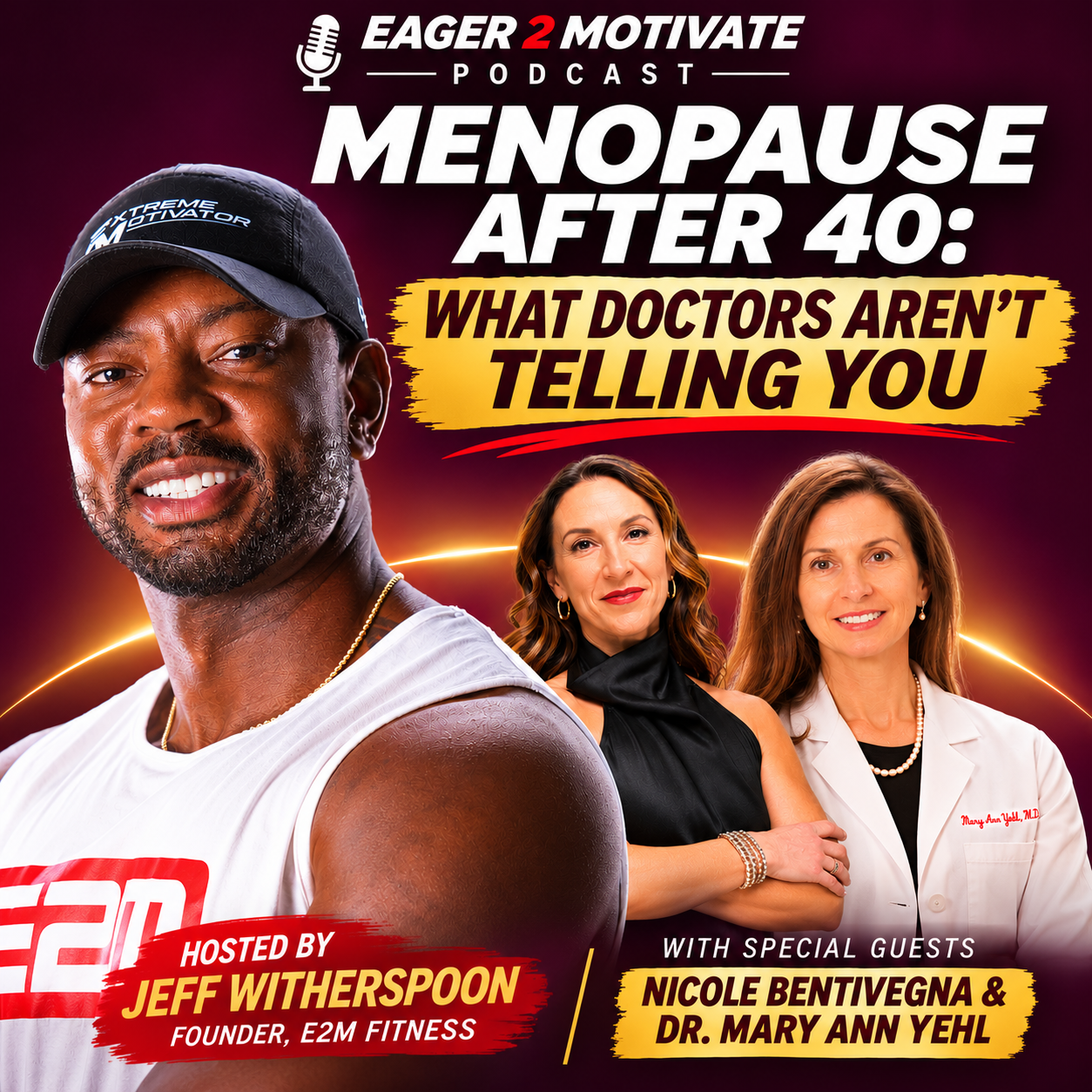
[00:00:15] Speaker B: Hey, what's going on, guys? Welcome back to the Eager to Motivate podcast. Today I have a special treat for you. We've had two amazing podcasts with two amazing women and we've gotten nothing but good feedback from both of their podcasts. So I said, hey, why not bring them back together? So I brought the two ladies back together, so you get the double scoop. Two scoops of perimenopause and menopause information. So I won't hold back from letting these ladies properly introduce themselves. So in no particular order, I will let Nicole. Nicole tell them if they didn't watch the other podcast and they came back looking for more, tell them who you are and a little bit about yourself because you are a superstar. You and Dr. Yell, you guys are beasts. So. So please lead off with the intro.
[00:00:56] Speaker C: Sure. Will do. Thanks for having me back. I am Nicole Bentavania. I am known as the Charlotte Menopause NP here in the Charlotte area. I'm a double board certified nurse practitioner in women's health and adult health and menopause. And functional medicine is my specialty. I help women in midlife make it the best time in their life because women deserve to love the way they feel.
[00:01:16] Speaker B: I love it. I love it. Dr. Yale, you're next.
[00:01:20] Speaker D: So I'm Marianne Yell. I am a board certified family med doc. Before med school, I was a nurse practitioner, midwife. So I'm kind of a hybrid model and I run an office called Coastal Women's Medical in New Jersey. But I see patients throughout the country and I do perimenopause, menopause, concierge medicine for women. And I love it. And every day I just get to help women feel their best. Just like Nicole. It's the best job in the world.
[00:01:46] Speaker C: Thanks
[00:01:46] Speaker D: for having us.
[00:01:48] Speaker B: I love it, ladies. So I'm going to stick to my scripted questions, but I do have one opener for you because I think sometimes people need to understand when it comes to somebody taking care of others, where their passion comes from. So I'll start out with you, doctor. Yo, can you kind of tell us why you wanted to get in this field of study, why you wanted to get into perimenopause and menopause? Why did you want to become a specialist in that area?
[00:02:11] Speaker D: Sure. So, you know, I've been taking care of women since college, since I was a nurse, and I really didn't want to vary much from that. And, you know, I think where you are in your life is kind of what's interesting to you. So you Know, certainly when I was having babies, that was, you know, so much of my focus. And then after getting into that perimenopause phase, although I had treated it, you know, it's so hard because unless you go through something, you really can't understand it. And once going through it myself, going, and just kind of hitting brick wall after brick wall thinking, what? This is crazy, Crazy. The, the lack of care in this space, I said, listen, I gotta do it. So that's when I went out on my own and I opened a practice and, and now that's all I do. And I love it.
[00:02:54] Speaker B: I love that. And, and to kind of, you know, caveat on what you just said. Even me being a man, that's a personal trainer, a fitness coach, I've seen so many of my clients with varying degrees of information. Whether they got it off of chat, GPT or Google or whatever, it's like all types of information. And so I think having somebody that's a, a trusted person from like you just stated, is this, you know, invaluable. So Nicole, tell us, why did you get into this field? Because you're an expert as well. So why did you get into the field of perimenopause? Menopause?
[00:03:25] Speaker C: Yeah. No, I think Dr. Yells, you know, hits the nail on the head when you're in that space. I mean, I took care of, I did a lot of OB in my younger years and after I had my daughter, my second child, I didn't know it at the time because as Dr. Yale will tell you, we really don't get a lot of care of the women over 40. I don't think perimenopause was in any of our textbooks. And I think I got this much menopause training and so I didn't know it at the time, but after my, in my early 30s, after my daughter was born, I was going into early perimenopause with horrible symptoms, terrible anxiety, night sweats that had me soaking through the sheets. It was awful. And I didn't know it at the time, so I didn't know what to do. And I was fortunate enough to work for some really forward thinking OBGYN who were interested in the menopause space space and got lucky enough to start some training. And once, you know, you cannot unknow and it was life changing to start to get into more of a root cause medicine approach and functional medicine and realize that there was really a whole other side of how to do,
[00:04:28] Speaker B: you
[00:04:28] Speaker C: know, the why behind your care instead of the what right in conventional medicine, we're typically trained to ask, what's the, you know, symptom? What do we call it? What's the diagnosis? And then what's the prescription? We write for it. But when we look at a root cause and we ask, well, why is all this happening? Why do you have frozen shoulder? Why do your ears itch? Why do you feel anxious? Why do you have night sweats? And we really put that all together, we can get to the root of the problem and resolve it without the prescriptions and the diagnoses and really take such a different approach to women's health and make such a difference in women's lives, as I'm sure Dr. Yale would agree.
[00:05:02] Speaker B: I love it. And the main reason why I brought that question up, ladies, is me. Me personally, what I've just noticed over the years of. Of military and now in the civilian world, that kind of stuff. I really like people who are passionate about what they do, because if you're doing something just for success or just for financial gain or whatever, you may not care about the person. But I wanted to bring you guys back because each time, each interview that I had with each of you, I could tell you truly cared about women and you wanted to help them. And it's a difference between just wanting to grab clients and wanting to get more people and really having a passion for what you do. And if I was to tell both of you guys you never had to worry about money ever again, I bet both of you would still want to do exactly what you're doing, and that's the kind of people you got to look for. So. Okay, I will start out with the first question for Dr. Yell. When A. When a woman comes in with perimenopause symptoms, this is a big deal for them. What does a good evaluation look like and what gets missed most of the time?
[00:06:04] Speaker D: Okay, so I. Well, for my patients, a good evaluation is a long evaluation. It's really giving someone the space and the time to hear their whole story. Because, you know, Nicole, I'm sure you'd agree, everyone has a story, and until you understand the fabric of that story, you're really doing a disservice treating them, because there's elements that you miss in terms of, like, this whole approach where we look at stress and we look at sleep and we look at what's going on with their kids and what's going on with their job and what's going on. What happened, you know, not like a psychological history, but, you know, what happened to them along the way that got them to this space.
And I think if you can give someone the space and the time and ask those right questions, really going through, like, every body system, looking again at the things nutrition, exercise, sleep, stress, all these different things, their sexual health, their financial, like the whole picture, then you can really get a good idea of, of what they need. Because, you know, you can have a woman come in and say, I have night swe.
And, you know, you'd be focused on that. But at the end of the visit, she's like, well, what I really wanted to do is treat my ADHD because I can't function at work. And you're like, oh, well, I didn't know, you know, so really having the time and the space to figure out their background and what they're there for.
And I think a lot of what gets missed in perimenopause, because it affects us head to toe, are sometimes other things.
Sometimes women will say, gosh, you do a really comprehensive panel and you're really asking me a lot of questions.
And I was going, yeah, of course I am, because there's so many conditions that creep up in midlife and mimic perimenopause. You don't want to miss them.
So, yes, I want to do the labs. And if they come back normal, great, then we've ruled out pathology.
That's wonderful. That doesn't mean that you don't feel the way you feel. That just means we've ruled out bad things.
So I think doing like a really, really good history physical and labs is a huge part of it. And oftentimes I'll see someone come in, for example, with joint pain, and they have this terrible perimenopausal joint pain. And I'll run a test, like, called an ana, that's a screening test, and they'll end up having rheumatoid arthritis.
[00:08:15] Speaker C: And
[00:08:15] Speaker D: it got missed, you know, because everyone just assumed it was perimenopause,
[00:08:20] Speaker B: you know. You know, I think sometimes I. I just hope more people will watch these podcasts because that alone, sometimes when I'm more prepared for what's going to happen in an event or something, I'm going to. I can handle it better. So if a woman knows that when you go to this ex, if you haven't, or you. You're thinking that you're having perimenopause menopause symptoms, it's probably going to be a thorough exam. You're probably going to have a lot to discuss with the doctor or with the practitioner. You're going to have a lot to talk about. And so I think coming in there thinking it's going to be a quick, you know, come in, tell you what's one symptom and get out of there, that's actually not what you want to happen. And what you just said, Dr. Yale, is exactly what you. Somebody should be looking at the whole person to see what other things or what all could be going into play to have those symptoms. So that was a great answer. I hope people watch this and hear that so when they go get checked, they actually know what to expect. My next question is for Nicole. So, Nicole, for a woman in her mid-40s who feels off but has been told her labs are normal, where does perimenopause usually show up first and what should she be tracking?
[00:09:24] Speaker C: I loved Dr. Yale's eye roll there because, I mean, she. And I probably hear this constantly. And, and, and to no fault of the people out there that are really trying so hard to fit everything in in a seven or ten minute visit, they, they really can't, right? So perimenopause is what we call a clinical diagnosis. It is not. There's no lab for perimenopause. There may be trends and there may be signs that things are going in the wrong direction or that hormones are changing, because I call perimenopause pandemonium, right? It's hormone havoc. It's this giant roller coaster. One month you feel great, the next month you don't. Three months later, you know, it's back to the beginning. So it, it's confusing because it can vary so dramatically and there's no one size fits all. Some women have many symptoms. Others, some women have a lot of physiological symptoms. Other women have more of neurological, psychological, like the sleep or the brain fog or the mood changes, like their husband is chewing too loud and it's driving them crazy, or they're anxious for no reason, they can't drive on the highway anymore, and they don't understand why. I had a woman this morning come in and she's like, I'm gonna sit in front of you and just cry, but I don't understand why. So it's. Labs are important and we want to test what we're treating and we want to trend things. But because perimenopause is a clinical diagnosis, we really need to listen, right? And have the time. And unfortunately, a lot of providers, they don't have that time to listen to the whole story. But if, if you're thinking, you know, what are some of the symptoms that Might be coming. The probably the most common things I hear, definitely. Mood is a big one to change. Like, you're anxious all of a sudden. You've never been anxious before. You didn't just develop anxiety. You feel like you have adhd. Like, I call it squirrel brain. Like it's a pinball machine going off in your brain. And again, like, you go from being like on top of it, working, doing everything, and now all of a sudden you're like second guessing every decision, every email you're sending, like, and, and you're foggy. Like you just can't remember anything. Did I pick up the kids? Did I do what I was supposed to? What's going on? Insomnia. Waking at 3am is really common. Just again, all of a sudden your brain is popped up. You didn't wake up because you had to go to the bathroom. You woke up and now you're thinking your to do list is just running.
Some women wake up and they're sweating or they're having heart palpitations and then the infamous frozen shoulder, which was one of mine, telltale signs.
And that's not fun either. So those are probably the most common ones I hear. And again, it can be a constellation. And there are women that get through this with no symptoms. We just don't talk about those women. Don't tell your friends, but those are actually women I worry the most about because bone loss happens in perimenopause.
Heart disease. Heart changes can happen. Cholesterol can change, insulin resistance can change. Autoimmune conditions can pop up. And so for women that don't have symptoms, that don't know to start seeking care and being proactive and preventative in their 40s, we have to really find those women and say, hey, listen, you might need to get a comprehensive evaluation and start to get ahead of it so that you, you don't end up with all of these problems ten years from now and think, how did this happen?
[00:12:33] Speaker B: No, I love that. And so I want to put a note, put a pin on that for all the men.
Men should be, you know, so you can better help and understand your wives, you know, know what, know what to look for as well. So we just talked about what women should be looking for. You know, those husbands, the people who are closest to them that you know that person well and they're just not acting the same or something that's just off you. Well, you also might be chewing loud, but other than that, you, you potentially could be catching on something. So the other part about that I. I do. I do want to ask a lot of ladies in my. Because I'm in my 40s now, so I'm seeing it now.
How.
How often do you guys see. Either one of you can answer. Both of you can answer. How often do you see that people just are in denial about being in perimenopause? Because people around you may see, man, she. She was a little bit snappier than normal. A little bit. It's a little bit short with that person. I'm not. I'm not used to seeing her snap at people like that. And so it's. People around you may notice it because, again, like I said, I'm in my mid-40s now, so I'm in. That target demographic of my friends are in the perimenopause menopause space. But for those people around you that notice it, but you don't notice it, how many people you know either don't want to accept it or don't notice it.
[00:13:51] Speaker D: So I feel like we probably see a biased population, right? By the time they come to us, they know there's a problem and they're wanting help.
So I don't see many women who are. I mean, there's a lot of women who come in and just say, I don't feel like myself.
[00:14:07] Speaker B: It's
[00:14:08] Speaker D: not just one thing. It's the compilation of all these small changes that when you add them together, a little anxiety. I don't want to go out anymore. I'm snapping at my husband. I'm less patient with my kids. I'm not sleeping as well. I don't really feel like exercising. And kind of when you add all those things together, they make them feel not like themselves. So not really saying, you know, almost more not understanding what all of it means.
At least I see rather than kind of denial. But I'm sure there's an element of that, too.
[00:14:39] Speaker B: Sure. Nicole, you got any comments on that one?
[00:14:41] Speaker C: No. I would agree we definitely see a biased population. But I think, especially now, I mean, social media is blown up, right? Like podcasts and Instagram and there's the menopause. Everyone is out there shouting from their social media rooftop like, hey, this is what this is. Right? And so you're talking to your girlfriends about how you feel, not like yourself. Your algorithm is going to send you, the people like us, to say, hey, like, this is what this probably is. And I think for some women, they think that, like, they just have to get through it, or they've been told, like, in the past, oh, you Just have to get through it. It's just 10 years. You'll be okay. It's just. Just get through it. Right? And so they think. I think women have. We've. We've kind of always been taught, like, just suffer. Just like, power through. Power through labor, power through this. Like, it's. It's this, like, rite of passage to just suffer.
And, and that's kind of unfortunately, like, how our previous generation, because they didn't have, you know, they weren't given HRT because of a, you know, terrible study 20 years ago. But I think it's. The tides are changing, and women are, especially Gen Xers, we're like, we're not doing this whole suffer through it thing. Like, with this. Enough is enough. Like, we've got to take care of ourselves, right? And, And. And take control. And women want to understand. Women like to be in control of their health. They. They very much want to know. And I think what's important is that we explain that this isn't. This is the second half of your life. Like, this is the rest of your life. Like, if we don't take care of this now, there's the risks. You know, heart, brain, bone, vaginal health, urinary health, skin health, like, immune health. It all can get worse, you know, decade after decade. And so I have had women who say, oh, I'm. I'm through menopause. And I'm like, you are, but it's the rest of your life.
[00:16:29] Speaker B: Yeah, yeah. No, that's. I mean, those are. Those are great things. And I think, you know, as we look at how people are getting information, I hope people watch more podcasts like this instead of just taking the random piece of information or nugget off of Instagram or Tick Tock. I mean, you got to look at the qualifications. So with that being. With that being said, I'm gonna go to your qualifications. Nicole, what do you wish women understood about what hormone changes actually do to sleep, mood, and belly fat? Because that's one I do see a lot on the TikToks and the social media.
[00:17:04] Speaker C: Yeah, there is a lot of noise out there. And that's. And again, I. I'm thrilled that that menopause is having its moment perimenopause, and people are getting out there and speaking and they mean well. Right. But it can be noisy, which can be confusing for patients.
So sleep, definitely. We need our hormones to be balanced for sleep. Right. Our hormones are starting our brain. Right. And so really, all of these hormones are brain hormones, because everything starts in the brain. And then it's just ch chemical signals sent through all throughout the body. And so as estrogen and progesterone especially go down, especially progesterone, it affects the GABA receptor in our brain, which is our calming receptor. And so that is where a lot of times we don't see as good of a sleep. So that's one of the reasons why sleep. A lot of women right now in this point in life, as Dr. Yale was saying, they're taking care of their kids, they're taking care of their families, they're in the height of their career. We're in the sandwich generation. We. We're stressed. And when cortisol is out of whack, that affects our sleep wake cycle. That affects our other hormones.
High cortisol increases our belly fat. As our estrogen goes down, our insulin goes up. Insulin's our fat storing hormone that increases our belly fat. And the reality is, Jeff, that the playbook that we had in our 20s and 30s is not the playbook we can have anymore. Those glasses of wine, the sugar, the dessert, staying up to all hours, not moving our bodies well, not dealing with stress well, if we aren't taking that foundation of health and changing it, we cannot do the things our college kids are doing. It doesn't work in your 40s, you do have to, like, really rein it in. And for women who never had to work hard, never had to really exercise a lot, never had to worry about what they were eating, never had to worry about how much they slept, it's even harder for women who have always had to struggle through this to keep their. Maintain their weight, or they didn't feel good if they weren't taking good care of themselves, they tend to get it and do a little bit better. It's the ones that have never had to do this that now it's a wake up call, and they're like, wait a minute, I can't get away with this anymore. And I think Dr. Yale has something to add to that because she's nodding her
[00:19:16] Speaker B: head
[00:19:17] Speaker D: no. I completely agree. I mean, you hit the nail on the head when. When you've had to fight for this your whole life, you've had to have good sleep, hygiene, you know, good eating habits and exercise, this is a little bit harder. But when you've been the person who's, you know, skinny, mini, who just eats anything, you know, feels refreshed after five hours sleep, this really is like a big, you know, gut punch.
[00:19:43] Speaker B: Look, Dr. Y', all, I'm gonna stick with You. And I got a question for you because this is a big topic.
So hormone therapy is the question every woman asks about who is it for, who should be careful, and what should she be asking her doctor.
[00:19:58] Speaker D: So I think the start of it is that hormone therapy should be a conversation for every single woman. And that doesn't mean that every single woman should get hormone therapy or is a great candidate for hormone therapy, but they should know that it's out there and why we give it, you know, it's, it's a lot of protection. And, you know, really we see decreased risk of mortality with early start of hormones. Great benefits to the vagina, the heart, the brain, the bones. And you really can't look beyond that in, in some subsets of women. Right. Everyone should be offered it.
[00:20:34] Speaker B: And
[00:20:35] Speaker D: then I think it's really an individualized conversation. So not everyone's going to be a great candidate for it, but.
And it's not going to solve all the problems in the world, but I do think it should be a conversation and say, listen, this is what it can do. And this is where I think you are in the hormone conversation. And for some women, you know, they don't want to have that conversation until they're 50. Really. I mean, I think at 35, we should kind of initiate like, hey, these changes might be coming down the road and if you start to notice your anxiety, start to notice your sleep changes, just come in and see me and we'll have a conversation.
[00:21:11] Speaker B: No, I love it. I mean, you know, I am curious about the ladies that are.
They have the confusion between they're early in the perimenopause space and they get told they need to. They get recommended to go on the hormones. And they're like, should I be doing the hormones? And people are saying, no, you're too young, you shouldn't be doing it. So what, what are your thoughts? Dr. Yellen and Nicole, you can chime in too, about being, being on hormones too early.
[00:21:36] Speaker D: I don't think there's a too early.
You know, if someone has symptoms, someone has symptoms, you know, and I think we've. There's a lot of opportunity for hormones. Even with patients who have different disorders, like, you know, PMOs, patients who have PMDD, where, you know, they're not using it for perimenopause, but for just imbalances. And they can feel just so much better using hormones. So I think there's a lot of opportunity in terms of, you know, when you can give it. If someone comes in and they're 40, and they say, I feel amazing. But, you know, I read Dr. Haber's book, should I Take hormones right now? No. Like, let's have the conversation. And, you know, hold on. And if you feel like something kind of creeps in, then we have it again. But I don't think it's a blanket statement that everyone should go on them.
[00:22:23] Speaker B: I'm gonna throw a curveball, ladies. If you are not prepared to answer this question, no problem at all. You can say, hey, I need to look more into that because it wasn't on my script.
Is there because I notice, and this is just me and what I do for a living every day.
I've noticed a lot of ladies that have that higher levels of cortisol, they're putting on more belly fat, they're gaining more weight. They. And they're not used to having to work to get it off. And this is not typecasting anybody. I'm just seeing this. And what I do for a living is what I do every day. I'm seeing more women go on GLP1s that. That are seeing themselves gain weight through perimenopause.
Is there any issue with being on multiple types of hormones, being on GLP1s and perimenopause hormones? Is there any kind of doing too much that could occur?
[00:23:13] Speaker C: No, there's not. So GLP1 is a peptide, so it's a little bit different than a hormone. But there's actually a lot more research coming out that hormone therapy plus a GLP1 is actually super beneficial, especially for cardiovascular health. But you're absolutely right, because as we were saying earlier, as. As hormones, especially as estrogen is going down, our insulin resistance is. Is going up, cortisol is going up. And those things are. You could. You could take, you know, I could give you all the estrogen in the world, but if your insulin is up and your cortisol is up, that belly fat is not going anywhere, right? I can put you in a bath of estrogen. It's not going to matter, right? So we need to get all the hormones balanced together, right? Even thyroid can change as we're going through our 40s. So hormones all need to be in balance, right? So whether you make a hormone or you take a hormone, we need them in balance.
And so that's really important. And cortisol is a really hard hormone to get under control when you're just stressed because you're trying to juggle all the balls and do all the things. And we do see as we go into perimenopause and menopause that we see women gain weight and the weight that we gain is the midsection, spare tire, belly fat weight. And that is bad for cardiometabolics. So I do think that especially for the women. Now, of course GLP1s have their place with like, you know, chronic obesity since you were a kid and they have their place with diabetes. But for the 40 plus woman who said, I'm doing everything, I changed the playbook, I'm doing all the things, my hormones are balanced, I've dialed it all in and these same £20 are still not letting me shop in my closet and put on my jeans.
Then I do think low dose GLP1s can really make a difference. There's there, they reduce inflammation. I had a woman today who, who's been on him and she, her, her rheumatoid arthritis symptoms are gone. Right. So reducing inflammation because when the body is not in balance, it's in an inflammatory state and that can be really uncomfortable and that can manifest itself as many different things.
[00:25:15] Speaker B: No, I love it. That's, that's great because I have to do a shameless plug here. A lot of people that get placed on GLP1s, they don't get the rest of the story, what else to do. And so I do have a book out for folks who are just starting out on GLP1s. It's called the Transformation Blueprint. You can find it on Amazon, but I won't do too much plugins, but you can find that on Amazon book out there, help you get started on GLP1s, how to, you know, eat right, work out that kind of good stuff so you get supported. All right,
[00:25:45] Speaker C: like, right. So you can't just take the GLP1 and keep going to the drive through and sitting on the couch. Right. It's like a tool.
[00:25:53] Speaker B: It is. It is definitely a tool. And so the other stools, the legs of the stool, as I say, the, the nutrition, the exercise, the mental well being, those things matter too. And so I teamed up with some folks and we put together a great guide for GLP1 users. So I got another question for Dr. Yo menopause touches heart, bone and brain health. Which of those worries you most for women who do nothing and what screening matters the most?
[00:26:21] Speaker D: That's a tough question. They're all important. They're all important and I feel very strongly about all of them. So I do screen women and it's so it. We'll start with bone. So bone is the most interesting and I'm sure, Nicole, you know, it drives you bonkers that the U.S. preventative Task Force says you should get a bone scan. So a DEXA scan, which is like an X ray of the bones to measure bone density at 65.
Now, women typically just going from perimenopause to menopause, lose somewhere between 6 and 20% of bone mass just during the transition.
Like, that's a huge amount of bone to lose. And Most women after 65 are, you know, they're not going back to baseline after they have a fracture. So I always get a DEXA scan, Even if someone's 40 and they're having these symptoms and really screening. I think one thing that's really, really missed is your patients with anorexia. Your patients who were athletes who had many, many years without periods, your patients who are hypothyroid autoimmune, like GI disease. You know, all those patients can have low bone density to start with.
[00:27:28] Speaker B: And
[00:27:28] Speaker D: my patients will get questioned all the time when they're 40 and someone else say, why are you getting a DEXA scan? You know, you're too young for this. No, I'm sure, Nicole, you find osteopenia and osteoporosis all the time.
It's sickening how much you find it good and bad, though. So you can start aggressively treating it. You know, exercise, vitamin D, calcium, agility training, all these things that we recommend to our patients so that they're not 65 and breaking bones.
So that, I feel like, is really, really important. And then, you know, certainly brain health. You know, many women will think as they come into perimenopause, they start to get this brain fog. They're distracted like that squirrel brain, like you said, and they can't keep their focus. And they. You know, some women even leave their jobs. One in 10 out of women leave the workplace during menopause because they just can't do it anymore, which is one of the saddest statistics I think, that we can possibly hear. So really trying to focus in on those women and helping them gain their focus again. And if they really do have cognitive deficits, treating those cognitive deficits, evaluating those cognitive deficits, getting their family history, doing tests like APO E3 buoy 4 to see what their risk is so that you can really tune in on that. And then for heart health, so many patients don't have or don't treat the basic things. Looking at blood pressure, looking at, you know, cholesterol, and not just standard cholesterol, looking at lipo a, looking at APOB and seeing where those numbers are. And again, I'm sure, Nicole, you see this. How long's your cholesterol been high? Oh, it's always been this way.
Are we just waiting for something to happen? Like,
[00:29:09] Speaker C: Right. They are. Right. Like you and I both know, right.
[00:29:12] Speaker B: We
[00:29:13] Speaker C: live in a reactive medical society. Like, they're waiting for the cholesterol to be high enough to put the statin. They're waiting for the A1C to be high enough to give them medication. They're waiting for the blood pressure to be so high they need a medication. We're not being proactive. And that's what, you know, providers like us, we are.
[00:29:31] Speaker B: We're
[00:29:31] Speaker C: getting ahead of it. If it's trending in the wrong direction, let's get ahead of it. Let's not wait until you meet the diagnosis. Let's get. Let's look up behind the scenes and start treating it now.
[00:29:45] Speaker B: I love it. So this. I want to remind you guys, this kind of. Or give you some background on this. This all came about because I had multiple ladies, so I trained. I'm blessed to be able to train a lot of ladies. And so a lot of the ladies that are in paramenopause and menopause was like, hey, we're hearing about all this strength training. I need to lift heavy.
I'm doing these. These hit circuits. And I don't think that's what I need. I need some strength training. And so a lot of people were saying, what I'm doing is not. What you're doing is not for me. And so I said, no problem. I gave you exactly what you want. This is what I do. And so I created a program called Strong Paws. We had great reviews about that. Lots of women did that program got stronger, feel good, look good, all the above. But, Nicole, I want to ask you about that. I don't want them to hear it from me because of course, I'm going to plug my. My programs and all my things. Of course. But what changes most for women in this season when she starts strength training and eating enough protein. So when a lady starts to work out even that category that you were saying that wasn't used to working out, when they start to work out the strength train and eat adequate amount of protein.
[00:30:52] Speaker C: Yeah. I mean, you and I have met in person. We did our podcast in person, since we're in the same town. And you know how important this is to me. Right? Like, building muscle is metabolic Spanx. Right. Like, this is so important for you. Like, your muscle is your best tool for longevity. It is going to keep your metabolism going, but you've got to fuel that muscle with enough protein, right? And so you've got to hit those protein goals for, you know, your ideal body weight. And your brain turns back on, your sleep gets better.
Brain health by far is probably the number one thing. You feel better, you see, sleep better, you function better. But exercise is the key to longevity, without question. And especially in Gen X we were taught, right, heroin chic, like really skinny Runway model kind of stuff, right?
[00:31:44] Speaker B: Like eat
[00:31:45] Speaker C: the little, eat the tiniest amount, you know, be skinny skinny. And skinny is out and muscle is in and it is so much more important.
So we've got to change what we're doing, get off the treadmill. Like I'm a, I call myself a recovered runner because I, for years and years and years since high school just ran and ran and ran and it did zero for my body. Now I strength train five to six days a week and I have completely at 49, completely changed my body, my body composition. I've never had. I have friends that call me guns now because I actually have
[00:32:19] Speaker B: seen them.
[00:32:20] Speaker C: I've seen
[00:32:20] Speaker B: the gun, I've seen
[00:32:21] Speaker C: them.
But, but you feel better and, and that, that muscle is so important for metabolism and it protects the bones that Dr. Yale was talking about, right? Like we underestimate like the risk of fracture, right? You get like women that fracture have a significantly higher risk of death in the year after a fracture. One of the number one reasons women end up in a nursing home is urinary incontinence and bone and fractures. And these are completely preventable.
With taking control of your health now, it's never too late. You can absolutely improve your muscle and bone health at any age. Strong pause was incredible to get women. It doesn't matter if you're 40, 50, 60, 70, you can still be working towards that. But you're right, the hit and just the cardio you've got to be lifting. I tell my women if it's easy, it's not working. It should be difficult by the last few reps. And that progressive overload will really make a big difference.
[00:33:22] Speaker B: I love it. Dr. Yo, do you have any comments up on about strength training and protein?
[00:33:26] Speaker D: So yes, the, the strong pause program, I think it's really important because I tell people too, you know, you have to do some, some kind of a progressive overload program. You can't just, you know, get the pink weights and, and lift them willy nilly in your room, you know, in your Basement. It doesn't work that way. You have to have some kind of a program and really some guidance.
And so, you know, women, I think here, lift heavy. Lift heavy. So they immediately go to the gym, they grab a big heavy weight, and then they come to me and they're like, I can't lift heavymore because I hurt my back last week. You can't just show up at the gym. Bing,
[00:33:58] Speaker B: bing, bing, bing, bing.
[00:33:59] Speaker D: Like, you have to have some guidance. So I love strong paws because it does give that guidance of, you know, form and structure, which is what you really need. And really, like Nicole said, it's really flipping it. It's on its head and saying it's not skinny, it's strong. That we're looking at.
[00:34:17] Speaker B: I will jump in. I'll jump in, ladies, and just say something. And you know, I'm never a fear mongering kind of guy. I'll just put a disclaimer out there. If you hear somebody talk about, you know, you need to lift heavy, but you don't have any guidance on what that looks like. A lot of women are like, well, let me just go lift the heaviest thing I can, like Dr. Yell said. And then you pull your back muscles. If you get a back injury, ladies, I'm telling you, it's going to be we or other kind of injury. So now you go in thinking that you're going to help yourself by lifting heavier. You strain something or pull something. Now you can't train at all. And so then you're going to feel like, oh, man, well, I can't train and I'm putting on weight. So now it's that mental component because you feel like, well, I need to do something, but I can't because I'm injured and I'm putting on more weight. So again, the cortisol is going to raise because you're stressed out, because you can't work out and you're gaining weight. So it's a never ending cycle. So that's why there's a program and I have a pretty good grasp on how well it works for ladies, even though I'm a man. Lots of ladies have trained in strongpaw. So if you would like some guidance on how to start strength training, please check me out or somebody that can help guide you and not just say, go lift heavy. All right, so I got a couple more questions, ladies, and I'll wrap this thing up.
So my next question to both of you.
What is the biggest myth about menopause? You hear that you want to, like, Put to rest today. You want to just like, I've heard this same thing on all these podcasts. Everybody comes in, asks me the same thing. This is a myth. I want to put a. A stomp to this thing. Anything that comes up to you guys that's kind of like something that's trendy in social media or trendy on Tick Tock and your clients come and bring it to you, like that's a myth. That's not really true either one of
[00:36:00] Speaker C: you. There's a lot.
Oh, I guess one of the ones I would think of really to probably kind of Talking about what Dr. Yale was saying earlier.
I still, even though it's how menopause is having its moment, I still hear women saying, my doctor said I'm not. I'm perimenopause. My doctor said my labs are normal. I don't need anything. So
[00:36:26] Speaker B: I
[00:36:26] Speaker C: would, I would argue we need to treat people, not paper. Right. And so if that is a myth, like, even if your labs look perfectly normal, I don't know what labs they're checking or a lot of providers are still saying we don't need to check labs. Right.
And again, I would kind of disagree that trends and testing what you're treating is important.
But look at the person, look at the symptoms. You're not too early. I was in my early 30s in perimenopause, and I didn't know it. Even if your periods are regular, that's a big myth. I hear that all the time. Well, my doctor said my periods are regular, so I can't be in perimenopause. You can absolutely have regular periods. You could be one of those lucky ladies that has a regular period all the way till menopause. Right. Don't tell your friends because they're going to be mad that it was easy for you. But it can be completely regular periods and still be very symptomatic and benefit from some form of potentially hrt. So I think that's important. And I do think there are a lot of very well intended non medical professionals out there that are trying really hard. And I think they're doing a good job of helping helping women with the foundational things like the exercise, the sleep and whatnot. But you cannot supplement your way out of menopause. Right. Like, this is like there's. There's no substitute for balanced hormones, and you really can't do that without prescription hormone therapy if you're a candidate for that. So for women that maybe are not a candidate for whatever reason, we are we do want to balance all the other hormones and we want to optimize their lifestyle. And there may be some supplements. Don't get me wrong, supplements are great for a lot of things, but there's no menopause supplement, right? That's going to protect your bones, your heart, your brain, your. All the systems that we need to.
[00:38:11] Speaker B: No, I love it. I love it. That's great. So I do want to ask one, One closing question to both of you. So I'll ask it slow so you can think about it. Give us one thing a woman can do this week. They can do it right now. That costs nothing or very low cost to. To. To help out with any kind of perimenopause or. Or menopause symptoms. What's one thing they can do right now? That. That could be scheduling an appointment with you. But what's. What's one thing that they could do?
[00:38:42] Speaker D: I would say prioritize sleep. And what do I mean by that? So, I mean, try to go to bed and wake up at the same time. Try to have a cool room, avoid water and alcohol and a big meal before bed. Avoid screen time, and really create a sleep ritual. And try to abide by that. Not getting on your phone at night, not staying up late to watch movies, but just getting in your bed, having that cool, dark, calm environment to make the most of your sleep.
I find that when people don't sleep well, that really snowballs the rest of the day into bad food choices, caffeine, they're snapping at people.
You don't want to work out. Even if you do, you don't get a great workout. So I would say sleep is probably, for me, one of the biggest things that I prioritize and recommend my patients really try not to sacrifice.
[00:39:34] Speaker B: I got. I have. I have two. Two things on that before I let Nicole jump in.
I do know, because even. Like me as. Even though I'm a man, I brought two experts in, so y' all give me a break. But. But I know for me, I have very busy days. And so when I should go to bed, I stay up. And that's kind of like my little time to. To look on social media or surf the Internet or. I like cars, so look at cars or whatever. And I researched that one time, and it has a term to it. It's called rebellious insomnia. So I could go to sleep, but I'm making myself step because I felt like I didn't get enough time for myself throughout the day. And that happens to a lot of moms and so I think that, you know, we're busy working. Professional ladies. And so I think that hearing that from you guys, it's just like, you got to put the phone down.
I know you didn't have a. You didn't have a chance throughout the day to breathe or. Or to have time alone to yourself. But that sleep is way more important than that 30 minutes or hour scrolling Instagram or tick tock. Get to sleep, get to bed. You're hearing it from two professionals. That's saying sleep, sleep, sleep, not Instagram. Tick tock. I also add to that.
Look into this. And ladies, y' all can chime in if you want to, but sometimes we don't realize how much social media is adding to our cortisol level.
Sometimes there's some things you see, because if you. If you don't believe me, find any celebrity you want and look at the comments and look at how many people are mad at them in the comments. That's cortisol. That's stress. They got stressed out because they saw Kim Kardashian wearing something they don't like, so they had to go to the comments and tell her how much they hate the dress. Stress. Cortisol stress. So sometimes when you think you're doing something to relax or unwind, if that thing you're doing to relax or unwind is actually driving your stress level up because you're seeing somebody you didn't know for 10 years and they got remarried and now you're all in a death spiral or trying to figure out who they got married to and all this something. So I'm telling, y' all know I'm right. Y' all know I'm right. And so some of this stuff, you know, when you think it's just like decompression time at night, man, go to sleep. Go to sleep. All right, Nicole, on to you.
[00:41:50] Speaker C: So sleep. I was. We were on the same wavelength there because we were both going to say sleep is number one, but there are two things exactly to the point that you were just making that I was ready to make, which is one, turn off the notifications.
We do not. If we need to know that the world is coming to an end, somebody will let you know. Turn off your notifications. Pretend it is 1990, and stop the notifications on all of your things. Be in the moment to be in the moment. Be in your work day. Be with your kids. Be with your spouse. Be there. Turn those notifications off like every. You will find out when you're meant to find out whatever needs to happen.
Say no. Women are terrible at saying no. We want to do for everyone. We want to be everyone. We want to. We want to juggle all the balls. We want to say yes to everything.
And again, from a cortisol perspective, you've got to. It's okay to say no. Give yourself permission to say no. Take things off your plate that don't absolutely prioritize what is most important to you. You do not have to have a full time job and be the team mom and be the classroom mom and decorate this and be. And go out to dinner every single. You don't have to do all the things. It's okay to say no and to take a breath and to. To step back.
And that just means that you're making space for the things that are most important to you and that will absolutely lower your cortisol and you'll probably sleep better anyway.
[00:43:17] Speaker B: I love it. That's good stuff. So I don't want them to leave without knowing where to find you guys because I want them to find you. So I'm gonna start out with Dr. Yell because I started out with Nicole from the beginning, I think, or the other way around with Dr. Yale. Tell them where they can find you, tell them how they can get ahold of you. Tell them where you practice, Give them all the details.
[00:43:37] Speaker D: Okay, so my practice is called Coastal Women's Medical and I'm in person in New Jersey, but I'm telemedicine in New York, in Connecticut, Colorado, Washington, New Mexico, Michigan, and maybe I forgot one. And Florida. That's right, Florida. And you can find me on Instagram @dr. Marianne Yale. And I do have a course. So I know not everyone, just like Nicole, can come to us, but I do have a course for the perimenopausal prepared patient. So if you are looking to find a doctor who maybe isn't as well versed in it, it kind of walks you through what labs you should ask for, what questions you should ask, symptoms and things like that to try and make it easier and understand. So you can find that on my website. Again, coastal women's medical dot com. Thank you.
[00:44:24] Speaker B: We'll make sure we put all Dr. Yo's information in the notes as well. So if they didn't catch all that doc, we'll make sure they know. Trust me, they will know.
[00:44:32] Speaker D: Thank you.
[00:44:33] Speaker B: All right, and last but not least, Nicole, tell all of your stuff, where you practice, how they can find you, how they can get a hold of you. What's your podcast? What's your Instagram. Give them it all. Give them all of the stuff.
[00:44:43] Speaker C: Yes. So our, our practice is Signature Wellness. The website is signaturewellness.org we are here in Charlotte, so we treat North Carolina, South Carolina, we do telehealth and in person visits, but that's where we are. Brick and mortar practice is our podcast that launched just a few weeks ago is called this is Not Normal, the Menopause Podcast.
So you can find it on Apple Podcasts and iHeartRadio and all the podcasting, YouTube and everywhere.
My Instagram is the Charlotte Menopause NP.
Instagram is mostly where I am. So you can see all the information that you're looking for. We definitely have the ability to have a, to offer you a free hormone guide. So same kind of thing. If you're looking for what to do next or what you're confused about or you know what the next steps need to be. Download the free hormone guide from our website. Our, our discovery calls are free. So if you're in the North Carolina area and you're thinking, gosh, this is exactly what I've been looking for, schedule a free discovery call on our website.
[00:45:44] Speaker B: I love it. Ladies.
Hey, listen, I appreciate you guys being here because you're super busy, so trust me, it's not lost on me that you, you kept an appointment slot for me. So thank you so much. I appreciate that because I'm not the normal client for you. So thank y' all so much for giving me an appointment slip to come and see you during this time. I'm thankful to have access to so many amazing professionals and I want to keep bringing them on these podcasts. So please tell your friends about them, tell them to watch it, copy the link, send it to them because you never know who will benefit because there's so much information out there. Somebody joked about this, but it's true. If you try to go on Google or chat GPT, you may find out you're going to die in five minutes and that's not true. So. So again, when you start having symptoms and things start going wrong, you want to talk to professionals. You don't want to just plug a little bit of information into the Internet and whatever comes out, you believe it. Get to a professional. Get somebody that's got lots of education and background. Both of these ladies, you saw how confident they talk. They're not. They don't play around. They do this for a living. It's what they do. They see lots of ladies. So if you can't see them, see somebody see a knowledgeable person, check their references, go to the best. Because your health matters. It's that important. You want to feel good. We want you to feel good, too. So, ladies, thank you all so much for joining me. I hope people reach out to you. I hope they follow you on Instagram. I hope they watch your podcast, hope to download your program, everything, because you guys deserve it. Because I know you're doing this because you care. So everybody who watched today, thank you all for giving us the time. I can't wait to see you again. And I'm sure you may see these ladies these again. But until then, thank you for joining the Eager to Motivate podcast. Y' all have a good one. Peace.
[00:47:27] Speaker D: Thank you.