Episode Transcript
[00:00:01] Speaker A: Welcome to, Welcome to.
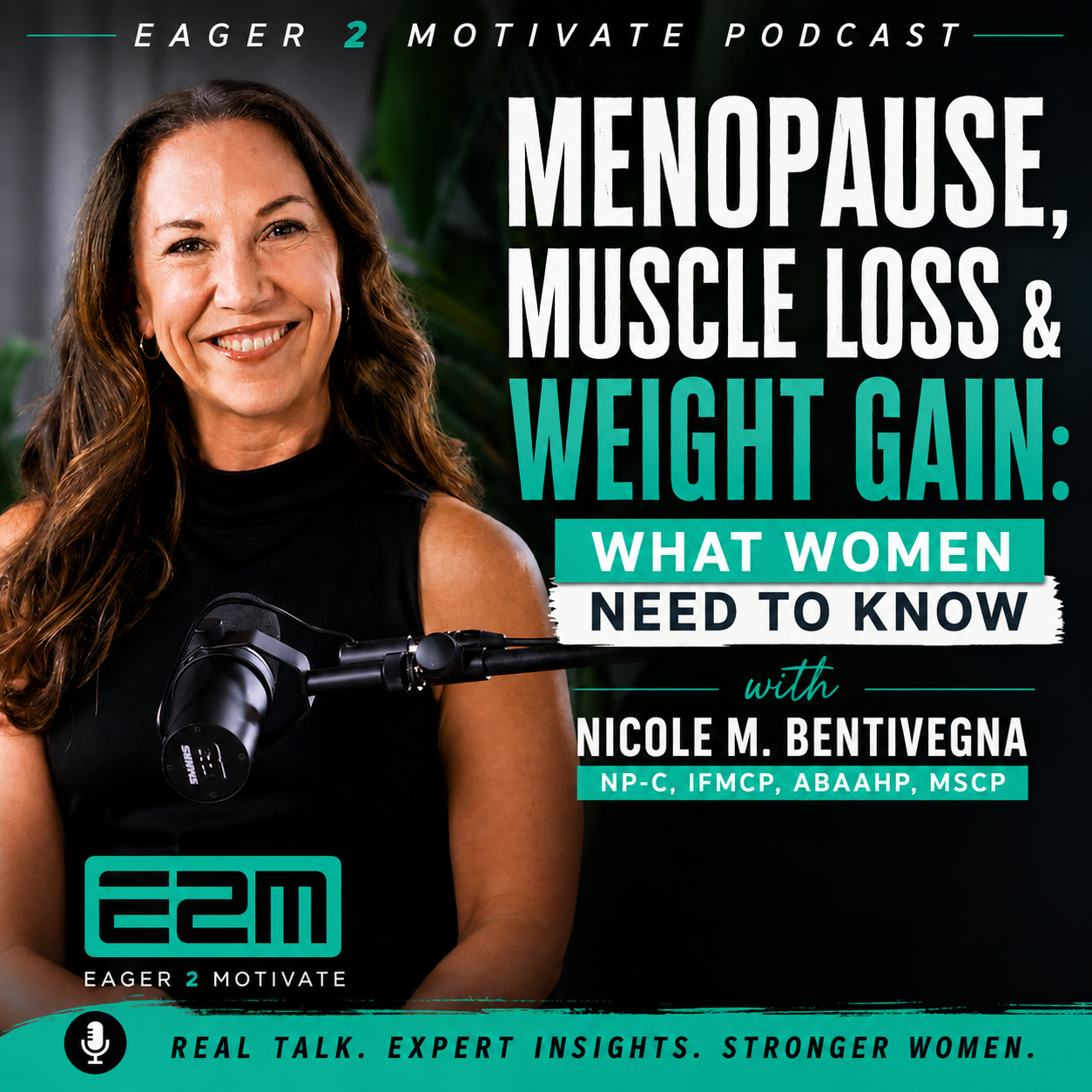
[00:00:13] Speaker B: Hey, what's going on, guys? Welcome back to the Eager to Motivate podcast. I'm coach Jeff and today I have a very special guest, Nicole mp. So y' all welcome. Y' all welcome, Nicole, to the podcast today.
So today we have a very special topic that I'm super excited to dig into and really get some answers from a professional. Because when we're talking about certain topics, we don't want it to come from a personal trainer or fitness person. We want it to come from the expert. And so today we're going to dive into the topic of perimenopause and menopause. So, Nicole and are you ready, Nicole?
[00:00:46] Speaker A: I'm ready.
[00:00:47] Speaker B: This is, this is a big topic. A lot of ladies, they don't play around with this topic. No, they, we had to make sure that we found somebody that had lots of experience.
And so I won't just say you have a lot of experience. I would love for you to tell everybody who you are and a little bit about your background.
[00:01:02] Speaker A: Absolutely, I'd love to. So, yes, I am Nicole Bentavania. I'm a nurse practitioner at Signature Wellness in Charlotte, North Carolina. And I have been dedicated to women's health my entire career. I feel so fortunate that I can say that I have been doing menopause and perimenopause and women's health in general for my entire career.
Started off in Richmond, Virginia and got down here. Yes, shop in the bottom. That's exactly.
And came down here about 10 years ago and had the fortunate luck of connecting with one of a world renowned medical doctor Deb Matthew. In this space of hormone therapy, of menopause, care of functional medicine, which really just means finding the root causes of what's going on for people. And so while we do care for men and women, we are known as the Hormone Clinic. Dr. Deb is known as the Happy Hormones Doctor I'm the Charlotte Menopause NP.
And so as you know, as you just said, menopause is having its moment. It is. Everyone's talking about it. It's a big deal. And it's about time because we have been doing this kind of care for over 20 years.
And because of a really terrible study a really long time ago, providers haven't been taught how to care for women in midlife. And that's all changing. And now doctors, providers are shouting from the rooftops, women are Gen Xers. We are not having it. We want to know what we need to do for the next part of our lives to be the best part of our lives.
And I am so lucky to get to take care of patients and do that every day.
[00:02:43] Speaker B: I love it.
I'm telling you guys, we were like, where in Charlotte can we find experts? And we found you, Nicole. So thank you, first and foremost, for being here with us and for answering these questions. So, guys, I'm gonna go through a few questions, and Nicole and I will kind of spin off on some of these things, but I'm gonna jump right into it because I don't want anybody to miss anything. So I want to keep it kind of short, but. But to the point. So many women are told weight gain and muscle loss are just a part of menopause. What actually happens to their bodies during this phase? And why does strength training matter so much?
[00:03:18] Speaker A: Yeah, that's such an important question. I have women every day coming in, and one of the number one complaints we get is, I'm gaining weight. I'm doing nothing different. I'm eating the same foods. Right. I'm exercising the same way. But what worked in your 20s and worked in your 30s does not work in perimenopause and menopause. As hormones are changing, as estrogen is going down, we lose muscle as we age, and we need to preserve it.
So cardio bunny on the treadmill is not going to do it. We have to lift. We have to build muscle back. Right. That's what's really important.
Muscle is metabolic. It's metabolic tissue. And in order for us to build muscle back and to have better metabolism, especially in our 40s and beyond, we need to be lifting in order to build that muscle and eating the right foods to build that muscle. And so, yes, weight gain is absolutely a part of aging for women, but it doesn't have to be a life sentence of ten pounds every year, over and over, we can modify, we can make changes, we can balance hormones, we can change the diet, increase the strength training and make all the difference.
[00:04:28] Speaker B: You know, we created a program recently called strongpaws for our clients. Yeah, the clients that were saying that some of our other programs didn't exactly fit what they needed in this phase of life. So for me, as a fitness professional, no problem. I can create exactly what you need. And so we did that. So from the strength training component, we have that covered.
What I am excited about is being able to bring more to the table, like professionals like you, to reinforce what we're saying. We're saying how important strength training is and proper diet and sleep and that kind of stuff.
They hear me saying It. But of course, I'm a man.
You know, like you said when you walked in, you said, hey, I know about hot flashes. You talked about it. But not only that you experience it, you also know it from a medical standpoint as well. And so ladies out there that's watching this, you know, we want to make sure, you know, that we're not just shooting from the hip here. We're also bringing in professionals to talk about the same topics that you hear us talk about in our program. So go ahead.
[00:05:29] Speaker A: The science supports that, right? The science of longevity absolutely supports that. In order for women to preserve bone. Right. That is so important. As we age, we start to lose bone mass, starting even as early as our mid-30s. And in order to preserve that bone, what do we need to build around it?
[00:05:49] Speaker B: Muscle.
[00:05:50] Speaker A: Right. How do we do that? Strength training.
[00:05:52] Speaker B: Okay, so. So now. Now we're going to jump at that. You have given me the alley oop, as they say, for my next question, because, like, I just introduced, I talked about, you know, the fact that we have a program for ladies in perimenopause and menopause called Strong Pause. And so in that program, we talk a lot about progressive overload. We've talked about that with our clients for a long time. And that's like a. A concept or a term that's a little bit tricky for some people.
And so can you explain what progressive overload means in simple terms and why it's especially important during perimenopause and menopause?
[00:06:28] Speaker A: Absolutely, Jeff. So simply, progressive overload means telling your muscles to do something harder, stronger. It's that lifting the next set of weights, it's going from 10 pounds to 12 pounds. It's doing the extra three reps. It's doing something different.
Our muscles have memory, and if we're doing the same thing all the time, we. We're not going to give the muscles the signals that they need to work harder. So progressive overload gives us that signal. There's so much data. There's a really big study called the Lift More study that came out that actually proved that you could really improve muscle and therefore bone strength if you're doing structured progressive overload in women 40 to 60. So it makes a really big difference. If we're. If it's easy, it's not working. Right? Right. If. If you can. If you can do 20 reps, it's too easy, Right. We have to do it. You know, we have to go to the next set of weights. We have to go harder. We have to go stronger. So that, that's really what progressive overload is.
[00:07:34] Speaker B: We've been talking about it. You heard it from Nicole. Gotta increase those weights, ladies. Don't be afraid. Try that next setup. Whether it's a two and a half pound jump, a five pound jump, that's how you get progressively stronger. You got to challenge yourself. You may have a struggle face, but I guarantee you nobody shouldn't be. Nobody should be recording you while you have your struggle face. But you'll be okay. But okay.
[00:07:55] Speaker A: And being told to do it right, it's not easy to do it on your own. The motivation talked about that. We talked about that. The motivation to do it yourself is not the same as someone saying to you, okay, one more set. Okay, let's go to the next weight class, right?
It's a lot different when you're being pushed, right? When the teacher is telling you, when the coach is telling you to do it.
[00:08:23] Speaker B: So at home, when we tell you to increase your weights, you gotta do it. Nicole said, listen. So with that being said, you know, I joked about it a second ago, but some women are a little nervous about lifting heavier because they think cardio is the only way to lose weight.
What would you say to someone who is afraid of strength training? That it will make them bulky or look more manly?
[00:08:48] Speaker A: I definitely get that. I think, especially in the generation right now of menopausal women, perimenopausal women, these are women that lived their whole lives being told cardio, cardio, cardio, right. And that the number on the scale was all that mattered. Right. And so they just think skinny, like heroin chic. Well, that was in. Right back in the 90s, that's, that's what everyone wanted to look like. And the reality is that we as women really don't have the, the chemical and hormonal makeup to get bulky. I mean, you would need mega doses of testosterone, right, to really do that. We are not built that way structurally, hormonally, what building muscle is going to do is it's going to give you contour, it's going to give you leanness, it's going to give you strength, it's going to make you look real good. It's going to give you that physique that you're looking for. And while, yes, muscle weigh may a little bit more, it is leaner and metabolically stronger. So in the end, yes, the scale may go up, but it's about body composition, not about what the scale says.
[00:10:03] Speaker B: No, that's true, Nicole. And I think you Know, I try to talk about this in a light manner because, you know, I never wanted to be seen skewed as negative towards somebody. But the ladies that these women feel like they're going to end up looking like they put in years, lots of supplements, hours and hours at the gym. They don't just do a couple of heavier dumbbells and now they have big, huge arms.
[00:10:28] Speaker A: Right.
[00:10:28] Speaker B: They have to work at that for a long time. They have to have supplements. They have to have sometimes, you know, help with testosterone. They have to have additional things to end up being that bulky, that blocky. And so it's not going to be something that is going to happen the way most people think in their mind.
[00:10:44] Speaker A: No, definitely not.
[00:10:45] Speaker B: Lifting five pound heavier is not going to make you look like, you know, I think I got some decent arms. Look like, you know what I'm saying? There you go. Like you want to have Nicole's arms.
[00:10:54] Speaker A: We want good arms. We want good shoulders, we want good quads. I have been strength training with trainers for over a decade. None of the ladies I work out with, and they're all my age, 40s, 50s, no one is bulky. We are leaner, we are stronger, but we are not bulky. That takes way more effort.
[00:11:12] Speaker B: I have seen it with my own eyes. Not once or twice, thousands of times. All right, okay, so now we're talking about the strength training part. But just like anything else, nutrition plays a really important part. So what role does nutrition play alongside strength training during menopause?
[00:11:29] Speaker A: That's such a great question.
We use building muscle. We use strength training, you know, to tell our bodies that there's. There's something we want it to do.
[00:11:38] Speaker B: Yep.
[00:11:38] Speaker A: But we need to fuel that. That signal. You have to fuel that signal. Most of muscle is what, it's protein.
[00:11:45] Speaker B: Right.
[00:11:45] Speaker A: We've got to give it what it needs to eat. Right. You wouldn't give the dog the wrong food. You wouldn't give the chicken the wrong food. We got to give ourselves. I use the car analogy all the time. We would never put the wrong fuel in our car.
[00:11:59] Speaker B: Right.
[00:11:59] Speaker A: We. We don't do that. We do not fuel the car wrong. We. But we fuel ourselves wrong.
[00:12:04] Speaker B: We must have been listening to each other, because I talk about that all the time.
[00:12:06] Speaker A: It's true.
We know we only have. We only have this one body. Can't trade it in. It's not on lease, it's not on loan. We can't get a new one. It's the only one we have.
[00:12:16] Speaker B: But.
[00:12:16] Speaker A: But we don't treat it well. And so if you want to use the strength training to your best advantage, you've gotta fuel it with enough protein. That's really, really important.
[00:12:27] Speaker B: You know, I'm gonna use you as an example, Nicole. You were talking about cars a second ago.
[00:12:31] Speaker A: Yes, we were.
[00:12:32] Speaker B: And you were talking about how, you know, if you have a nice car, you don't wanna get a door dinged, you don't wanna get a flat tire.
Our bodies are way more precious than any car we could ever drive. We gotta think about our bodies the same way. Like, what are you putting into your body? You wouldn't put bad fuel into your brand new car. You wouldn't drive your brand new car through some mud. You would take care of it. So this one body that we get, we got to take care of it, too. I know it's harder than I'm making it sound, but if you think about it in that concept, like, this is. This is your most prized possession. The body you live in. You got to take care of it. Okay, now I'm going to go off on a tangent. Like, I love this stuff. Okay, so the next thing, there's a lot of podcasts out there.
There's a lot of information out there. Now we're in the TikTok and Instagram and social media world. So, you know, there's a lot of sensationalized things, right? And it's just the world we live in.
The most sensationalized thing you say will get you more clicks and more views. So if I say all women must do this, oh, what do we need to do? And so that's gonna get clicks and that's gonna get conversations. Even some of the negative stuff is on purpose. I want you to say, no, we don't. So I can generate more buzz, more views. And so with all the information out there, are there specific things that women should prioritize when it comes to protein and fiber and fueling their workouts? What should they prioritize? So if they had to cut through all the noise and what this person is saying on the podcast and what that person is saying, if they had to cut through the noise, Protein, fiber, things like that, what. What are they really needing to help fuel those workouts?
[00:14:06] Speaker A: And I couldn't agree with you more. We are living in a world that's just bombarding us with information. And especially now in the world of AI, right, We've taken it to a whole another level. What's truth? What's real? Right. It's just becoming Cole is very real.
[00:14:20] Speaker B: I'm Very real.
[00:14:22] Speaker A: You're really here.
But it's true. It's definitely harder. And one of my priorities is to put out good content to my patients in the area. But I want to keep it simple for people because really, really, as you know, Jeff, this should not be complicated. I don't want my patients who are overwhelmed, not sleeping, hormonally imbalanced, aggravated, frustrated. I don't want it to be difficult. I want it to be simple. And it can be. And when you think about what you said, prioritizing protein. Right. Prioritizing fiber. Fiber should look like color on your plate. Fruits and vegetables. Right. Real whole. So if you're eating the right fuel for your body, it doesn't have a food label. Right. It doesn't come in a package. It doesn't have a list of ingredients. It's just the real food, and that's the easiest way. One other thing I think is important when it comes to fueling your workout is creatine.
[00:15:19] Speaker B: Hold that thought before we jump into that. Hold that thought.
Because I have a lot of people that want to jump into specifics, and I don't want to add more complications to their lives. So when they ask me, what should they eat, and I say, lean meats and vegetables. Right. You just said that. Right.
Healthy fats, those kind of things, it sounds like it's a generalized statement. But when I'm saying that, I'm saying it on purpose. I don't want to add an extra layer of stress to like, oh, I can only eat these.
I've had programs in the past where building discipline is a part of the program. So I'll tell you to eat these certain things because I'm trying to get you to build discipline.
[00:16:05] Speaker A: Sure.
[00:16:05] Speaker B: The purpose behind it is not just to torture you. It's to say, hey, if I can only eat these foods. Now I understand what it's like to look at a menu in a restaurant, and I see all these appetizers that I could order, I could eat, but I'm going to choose the protein and choose the vegetables.
So my concept with those kind of programs is I am limiting what you eat to help you build a discipline. So when you're faced with all these unhealthy choices, you can weed through them and make healthier choices.
But when it comes to perimenopause and menopause, I don't want to add an extra layer of struggle or challenge that you can't stick to this couple of meals or foods that I'm giving you. I make it generalized because if you can find proteins that you like, go for it. If you can find vegetables that you like, go for it. What's your thoughts on that? Do you think women would do better with like eat broccoli, a piece of salmon and some nuts, or would they do better with, hey, keep it in this category?
[00:17:03] Speaker A: And that's where I think we have to personalize things for people, right? We take a very one size fits none approach, a lot of shared decision making.
Personalized medicine is the way medicine really should be practiced these days. And that's what I do. Personalized medicine.
And so when I'm with a patient, I'm asking, do you want a meal plan, five days, exactly what you want, or do you want a general understanding of These are the categories. And I want to make it simple, right? If it doesn't have a food label and it doesn't come in a box or a package, if it came from the earth, if it walked on the earth, it swam in the water, fell from a tree, or grew from a garden, you can eat it. And for people that want to have, have, you know, don't want to think about it, right? Do we just tell them, all right, this week it's chicken and it's broccoli, next week it's salmon and asparagus, the week after that it's, you know, whatever. So I let patients make those decisions and cause some people love the variety and love to be creative and other people like me, look at my fridge, it's just a bunch of Pyrex. Everything's food prepped, everything's ready. This is what's being, this is what I'm eating for the week because I don't want to think about it.
[00:18:14] Speaker B: And that's a smart way to do it. So, okay, I'm jumping to my next question. Many women struggle with symptoms like fatigue, poor sleep, joint pain and low motivation, especially low motivation to do exercise workout.
How can exercise and healthy habits help support these symptoms without it feeling overwhelming?
[00:18:34] Speaker A: That's so true. Those are probably some of the top symptoms I get in 40 plus year old women. And reality is, is that this time in life, women, 40, 45, 50, usually you've got kids that are teenagers causing wreaking havoc. You've got aging parents, maybe you've got a career that's taken off. You're in this sandwich generation of so much going on. And a lot of that is due to stress, right? You're not sleeping because of stress. You're not, you know, your muscles hurt because you're not eating the right foods, you're not getting enough rest, your hormones are changing, so your mood is off, you just don't feel like yourself. Right? We always say that there should be a diagnosis for I just don't feel like myself anymore. And that's what women are feeling. And we want to feel in control.
And we have control over moving our bodies. We have control over prioritizing that 15 minute walk. We have control over going to bed at the right time, over what we fuel our bodies with, how much we hydrate. So I think that yes, we can improve some of those symptoms by exercising. Exercising is brain food.
It makes you think clearer, it gives you more energy. It sounds counterintuitive. When I'm tired, I should exercise. No, maybe you shouldn't, you know, do the hardest thing that day. Maybe you should stretch, maybe you should take a walk. But I think that we wanna have some control over those things. And I think, yes, exercise, yes, nutrition. But if you're feeling all of those symptoms, you may need to think about menopausal hormone therapy. You may need to think about, does your thyroid need to get checked? Are you having a lot of inflammation? Do you need to look at these markers that someone can tell you what else is going on? Because it's a two way street.
[00:20:29] Speaker B: So we, we definitely advocate for that. You know, I advocate that as well. On the mental wellness side, like if you struggle with different things, there's nothing wrong with going to get a consultation. You know, if you're prioritizing what, what to spend money on, that's what to spend money on. That's one that's going to do a whole lot more for you than anything else. You know, a purse or a dress or whatever. Spend that money on some health and wellness things. And I'm not telling you what to do, but it's like, you know, if you can get a consultation from someone like Nicole or things like that, you may find out that some of the something that you're dealing with, there may be answers beyond just the normal things you may see on the Internet or podcast. So, hey, I do want to go back and I do want to give a disclaimer because I have to do that. These days we're not giving you medical advice. So if you decide to go this route on your own, please seek the advice of your own provider. But you mentioned creatine and a lot of people talk about creatine. Again, to make sure comprehension is comprehending. We're not telling you to go out and do creatine so don't go run out and say, Jeff said in the podcast, go to creatine. Talk to your provider about creatine before you do anything on your own, but tell us your views on why you prescribe or give some of your patients creatine.
[00:21:43] Speaker A: I am a food first provider, right? Food is medicine. Food is our first pharmacy.
We can't get everything through food. And so there are things I think that we can prioritize as we are going through this midlife hormone havoc that we're going through, and as we're strength training, as we're building muscles, we're eating enough protein, Creatine can make a big difference. It is one of the most innocuous, simple, inexpensive supplements, and it can make a big difference in our muscle health and in our bone health. And now the newest research is in our brain health.
[00:22:19] Speaker B: Oh, yeah. Oh, yeah.
[00:22:19] Speaker A: And for women who are struggling with brain fog, can't remember why they walked in the room, don't remember the name of the person next to them, Brain health is really important. And so I do think clean, high quality supplementation with something like creatine can benefit you.
[00:22:35] Speaker B: I love it. And that was a great thing to bring up because, I mean, you know, as I was preparing the perimenopause menopause strength training program, I watched a whole bunch of podcasts. I think I know more about perimenopause and menopause than most men do. And so I heard a lot of them talk about creatine and that kind of stuff. And so I think when it comes to supplementation, most women are a little bit, you know, confused on, you know, should I do it, should I not do it?
That's the time that I'm saying. If you're on the fence about something like that, that's when you get a consultation, somebody like Nicole or your provider, and you ask them, hey, do you think creatine would help me? How much? How many grams, things like that. So I definitely feel like it's something that's being discussed. So I'm glad you brought it up so that way. What about creatine? We don't have to answer that question 50 different times. Good stuff. All right, so the next thing, if a woman listening today is just getting started and feels intimidating, intimidated, what are two to three things she can focus on right now to build strength, confidence, and consistency? During this season of life, it's never
[00:23:43] Speaker A: too late to get started.
It doesn't matter if you've never worked out or never strength trained and this is new to you. 40 or 50 or 60, it doesn't matter. Consistency is key.
We don't want you going out, lifting 30 pounds out of the gate. Right. Start slow, start low, build that consistency.
You're gonna get so much more benefit by doing a little bit on a consistent basis. Right. We were talking about this earlier. You've gotta make an appointment with yourself. Right. And that can be hard, right, to have the motivation to do that.
But prioritizing that time with yourself. You wouldn't cancel the dentist appointment, you wouldn't cancel the orthodontist appointment for your kids. But we tend to cancel appointments with ourselves and we've got to prioritize that. So consistency, absolutely, I think, is one of the most important things I use. I tell my patients all the time, schedule six days, you'll get three.
If you schedule three, you might not get any. Oh, wow, Right. So if you put it on your calendar for six days, okay. If something know comes up. But you've gotta give yourself that opportunity, and consistency is gonna be one of the most important things you can do for yourself.
[00:25:05] Speaker B: I think the biggest thing I tell a lot of people is it's easy to get consumed with thinking that consistency means doing all the things. It doesn't mean that. It doesn't mean doing all the things. And that is a very easy way to get discouraged because you feel like, well, if the program says, I have to do this and that and this, and I couldn't do that and this, and I'm a total failure.
No, the goal is to, if you can do something, do what you can.
And that something could be going for a walk, right? That. That something could be. And people may not understand what I mean by this, and you can help me out with this, but that's something. Maybe take a nap.
You might need to take a nap.
[00:25:48] Speaker A: You have to listen to your body.
[00:25:49] Speaker B: And so I think that is the. That is the biggest thing when it comes to especially programs that I do. I'm not expecting anybody to be perfect. I'm expecting for you to try your best. And so with programs like how we do in my fitness business, let's say you went through a program once and you did most of it, you didn't do all of it. You can always restart, go back to the beginning and see if you can do better the next time.
Your health and wellness is going to be a lifelong journey. It's not going to be a finish line. You're not going to do something, and now you're fit for life. No you got to keep doing it. And so as long as you're looking at how, okay, I can clean my diet up. I can. I can do more workouts. I can get more rest. I can put down the Instagram, TikTok, Facebook, I can put it down.
Even though I want to find out what's going on with Nicole, where Nicole get address from. So I want to find out all the scoop, but I can also put it down and get more rest. And so it's always looking at the different ways to make progress, because progress compounds a little bit of progress today, a little more progress tomorrow. Before you know it, you made a lot of progress.
[00:26:54] Speaker A: So.
[00:26:54] Speaker B: Okay, Nicole, go ahead.
[00:26:55] Speaker A: I want to touch on that, because you hit it perfectly with the word perfection.
[00:27:00] Speaker B: Yeah. Yeah.
[00:27:01] Speaker A: Women are taught to be perfect, and that's just in our. It's in our psyche. If we're not doing everything Jeff said, if we're not doing it perfectly, then we're failing. We're just not doing it. And I say constantly to my patients, perfection is the enemy of good. I would rather you do 80 or 90 or 50% of something than 0% of something. Whether that's with what exercise you choose that day, whether that's with the nutrition in your body that day, whether that's how many hours of sleep you got. It doesn't have to be perfect.
[00:27:36] Speaker B: So that's real good. I hope you ladies hear that out there, because, I mean, I've been doing this for a long time, and when I talk to some clients and they kind of fell off and stopped training, I'm always curious, like, what. What stopped you? Well, I couldn't work out yesterday, and I couldn't work out today.
So now. So now I feel like I'm a failure because I didn't work out two days in a row.
No, just jump back in. Okay.
[00:28:04] Speaker A: You're gonna use the car analogy with that.
If you got a flat tire, he would not bash the other three tires.
Right?
[00:28:12] Speaker B: That's a good point. That's a good point. If you got one flat tire, you wouldn't toss out your other one. Let's go. Okay, so our last question, because we're getting. We're getting long in time here, because this is a great interview. So. Okay, so our last question is, what is one? I've heard a whole bunch of these, so I'm happy to hear what yours is. What is one menopause myth you wish more women would stop believing?
[00:28:34] Speaker A: Oh, there's so many, Jeff.
So many.
[00:28:37] Speaker B: I know them all because I Told you earlier, podcasts are all about views. And I hope you guys watch this or are watching this, because we're just good people that want to give you good information, not because we said something sensational just to make you get click on our video. But go ahead, Nicole.
[00:28:53] Speaker A: You know, I guess I would say the biggest myth is that I don't want women to feel that how they feel now is how they're gonna feel forever. If you don't feel good, if you don't feel like yourself, if things are changing, changes in your body, is your body telling you something's wrong? A symptom is a sign that there's something different, something's going on. And women change as we age, when we get through our 40s and 50s and our ovaries retire, because if you're a woman, your ovaries are gonna retire. And when that happens, you're going to likely feel different. Some women feel a lot different, some women feel a little different. But if you don't feel good, I always want women to know there are answers.
There are people out there like myself and people all over the country. I've trained many of them. That's what I do. My side hustle is I train providers to do what I do.
And it's important to know that if you are seeking help and you're not getting answers or you're feeling dismissed, or they don't know how to help you in your midlife, there are other people out there and you should never take, this is normal. This is how you're gonna feel, and this is just the rest of your life. Don't ever take that as your prescription.
[00:30:08] Speaker B: I love it. You know, Nicole, again, you know, I've appreciated having you come here because you dropped that in there, but I wanna have you highlight that again. So you actually are a trainer of other professionals on how to be experienced with perimenopause and menopause.
[00:30:25] Speaker A: I'm so fortunate to see patients all day, every day. Menopause, certified functional medicine, certified nurse practitioner for over 20 years. And with the expertise that I have, I want to impart that knowledge on as many other providers that want to know how to care for women in midlife. Because like we said earlier, menopause is having its moment. It's everywhere. There's documentaries everywhere, everywhere. Go on Amazon, go on Hulu. They're all over the place. And they are. There's people that are trying to get the information out there, but finding a provider in your area is really important. So I'm the Director of mentors for an academy called the BHRT Training Academy. And so I train other providers literally all over the world every day in addition to my role as nurse practitioner at Signature Wellness here in Charlotte.
[00:31:10] Speaker B: Well, I love that. And you know, we may have to do a part two so we can hear even more about. Because you had so many good things to say.
I don't want to leave without people knowing how to find you. You know, we tracked you down, so we hunted you down, so we found you. But I don't want it to be as hard for them to find you as it was for us. I wanted to know exactly where to go. So tell them how to find you on socials, how to go to your practice and be a patient. How.
[00:31:34] Speaker A: Yes. So it's super easy if you are someone out there that doesn't feel good and wants to explore and understand more. We do free discovery calls at Signature Wellness and so our website is signature wellness.org we are right here in the South Charlotte area, also in the Belmont area. You can schedule a free discovery call. You can follow me at Charlotte Nurse practitioner, Charlotte Menopause NP on TikTok and on Instagram.
So, yeah, definitely. So easy. I want to make it as simple as possible.
[00:32:04] Speaker B: Charlotte Menopause MP immediately. Follower count going up. Right now. It's blowing up. Well, hey, Nicole, I appreciate you being here, guys. I will have Nicole back, so please don't blow us up with 10,000 questions. We'll have Nicole back and we'll make it a series.
[00:32:20] Speaker A: Jeff.
[00:32:21] Speaker B: Yeah, we'll make it smart. We'll make it a series. So we'll bring Nicole back and we'll talk to her more because, you know, I. I do want to give you your flowers.
When we reached out to you and asked you, the first thing you said was, I just want to help people, you know, and that's beautiful. So I don't even know any of your patients or anything about you, but all I know is that when we reached out to you because of your qualifications, how warm you were and inviting you were about just helping people with information.
You know, if you are looking, I would look right here. So again, you know how to get in touch with her if you're in the Charlotte area? Do you guys do outside of the Charlotte area? That's the. In your main area?
[00:33:01] Speaker A: We do, yeah. We do see patients outside of Charlotte. We're licensed in the state of North Carolina, but we have patients that fly in once, twice a year to see us. Yeah.
[00:33:08] Speaker B: Well, cool. Nicole, again, I'm super excited to have you back. I'm super excited to have you today. It was great talking to you guys and ladies out there. I just hope that, you know this will help you a little bit with more reinforcements from professionals that it doesn't have to be complicated, the perimenopause menopause space.
It doesn't have to be something that you just feel frustrated with. But no answer. There's a lot of professionals out there. You know, we've got the strength training part covered so we can, we can help you with that. But there's so much information out there that we're going to continue to try to have Nicole on and just bring information to help you feel like you can make some progress here that you can win. You can win the battle against perimenopause and menopause. I appreciate you guys. Thank you for tuning in to the Eager to Motivate podcast and I'll see you next time. Peace.
[00:33:56] Speaker A: Welcome to.