Episode Transcript
[00:00:00] Speaker A: What up, what up, what up? Welcome back to the Bad Podcast, Brad and Duane and man, this is gonna be a good podcast, y', all, but I'm gonna go ahead and put this disclaimer out there. Brad, can I do it?
[00:00:10] Speaker B: Do it.
[00:00:12] Speaker A: Listen, as two guys, we don't claim to know anything about menopause perimenopause. Never been through it, no people that's going through it. But we have no, we're not the experts at this. We have no recollection. I want to put that out there at the beginning, but Brad actually did something in the last 10 months, man, that, that, that, you know, it actually affect his body similar to the way a lot of women's go through. A lot of women go through perimenopause and menopause and the same frustrations and all of that. So, Brad, man, we're gonna get into this episode, but before we do, you got something to say before we hit this intro?
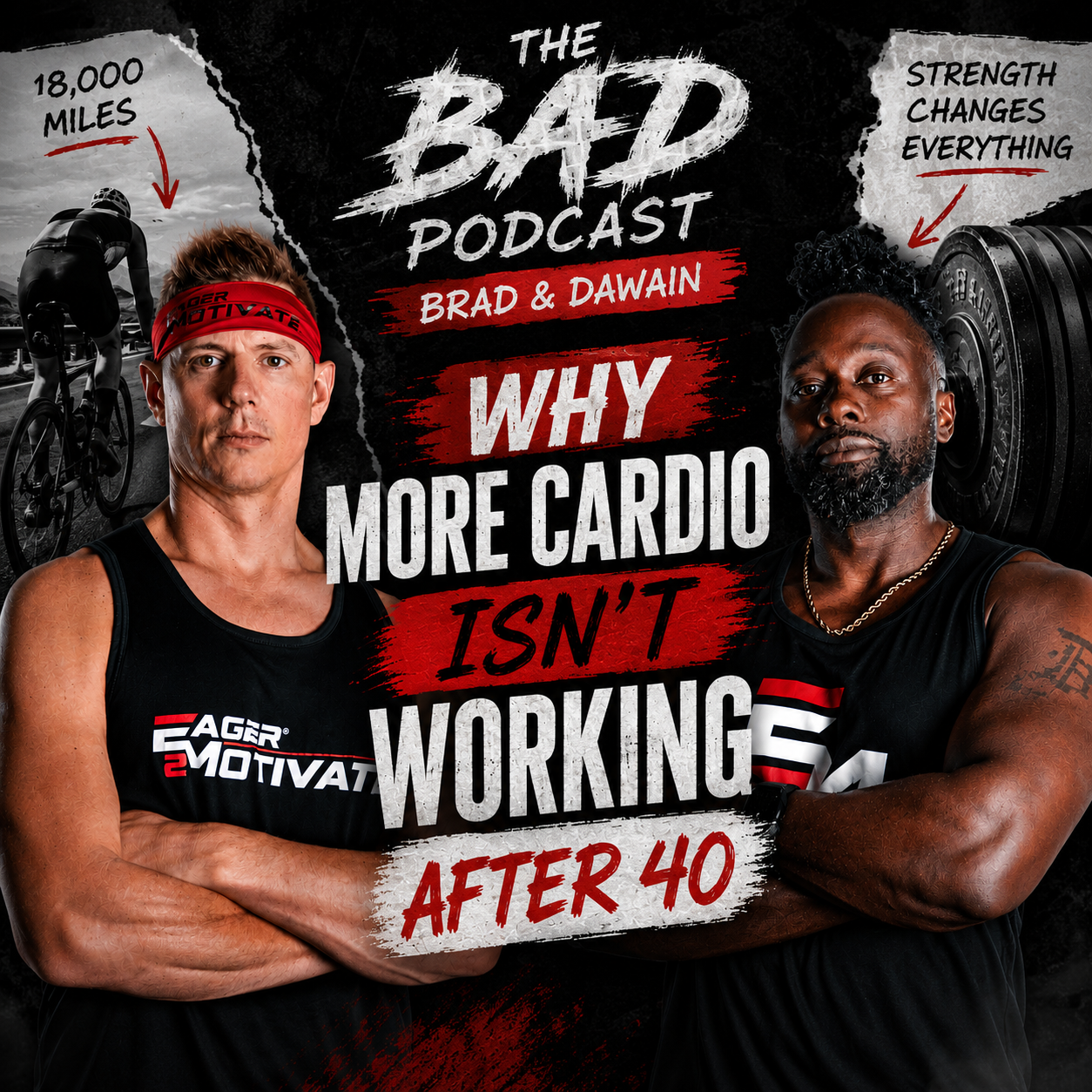
[00:00:52] Speaker B: I always have something to say. Hey, let's talk 10 months. Let's talk 17, 000 miles. Let's, let's talk some strong paws.
[00:00:59] Speaker A: I know it, man. Let's get it.
[00:01:05] Speaker B: Are you ready? Are you ready?
[00:01:21] Speaker A: What it look like, what it be like, what it do? Back in here, another episode of the Bad Podcast, Brad and Dwayne. And you know, Brad, I have to say when I say bad podcast, a lot of people didn't know what it stood for. And even when I kind of did a diagnostic with chat, it was like, make sure you tell people what bad stands for. Bad stands for Brad and Dwayne.
Not that it, I mean, we are a bad podcast. We're the baddest podcast in the land. You know, Michael Jackson Bad, but that's what it stand for, y', all, man. And so super excited to be coming to you another episode.
Really excited because this episode is dropping right along with our brand new program we just released in premium called Strong Pause. It's, you know, kind of pointed towards the menopause perimenopause aspect, man. So super excited about that. And we're going to talk about something, man, that, that runs right on line with that. Brad, man, what you got?
[00:02:15] Speaker B: Yeah, I, you know, over the last bunch of months, I, I did something astronomical and worked really hard, and that's sort of what we're going to talk about today. And over the past 10 months, I, I, I put in 17, more like 18,000 miles. And again, we're not going to claim and sit here on the podcast and say that we know Everything about perimenopause and everything about menopause, because we've never experienced what a lot of the ladies in E2M have experienced.
But what I can relate to is working extremely hard, training extremely hard, harder than I probably ever have in my entire life, and maybe I ever will in my entire life.
But as I was working hard, I didn't see the same physical product or the same physical appearance that I. I expected to see.
I was. I was training for five to seven hours per day. Like, I was. I was a sweating mess every day. I was eating a lot just to keep up with my training. And anytime I would look in the mirror, frustration grew because I was putting in the work. I was better than I had ever been.
You know, cardiovascularly, I was fitter than I've ever been in my entire life. And when I looked in the mirror, I just thought that I should have been a whole lot more fit than what I was Those. Those 10 months. And it was extremely frustrating.
So that is the one relatable piece that I have with perimenopause and menopause is you sometimes put in the work and don't see the physical benefit. Benefits from that work. So that's sort of what we're going to talk about today. We're going to talk about meeting frustration and. And all sorts of things.
[00:03:57] Speaker A: Yeah, no, and that's great. And I'm glad you kind of jumped into that, because what you went. By the time this episode drops, we actually have a podcast we did with a menopause perimenopause specialist that dropped the day before. So if you didn't catch it, go back and check that out. Just did an awesome job interviewing it. But one of the things she talked about, and even in our promotion of Strong Pause, you know, things that worked in the past or you thought would work, doesn't, you know, it's not necessarily what you need now. And she talked about, you know, the era of the cardio bunny. Like, everybody wanted the cardio. Cardio, you know, it was all about, you know, getting the cardio. You got all that. That's where all these treadmills and ellipticals and all of those. That's why you got so many, because that was the era. But. But, you know, the look that a lot of people looking for comes from strength training. I think you probably can relate to this, Brad. Like, I mean, you cardioed it out, but you mentioned not liking what you saw, you know, in the mirror, man. So. So talk about that a little bit.
[00:05:00] Speaker B: Yeah.
I cardioed it out, I went Energizer Bunny on it. And you know, I, I, I'm somebody that enjoys strength training. I always have. I, I like CrossFit. I like, you know, heavy lifting. I like all sorts of lifting.
Cardio is sort of my niche. I'm an endurance athlete and that's what I put myself through in the last 10 months.
And that's the frustrating thing because as much as I was working, I wasn't seeing those physical benefits.
And just these past three weeks, I've already seen transformation. I've seen my body shape change a little bit. I've seen areas that I have sort of seen fluffy over the last 10 months. I've seen them kind of tighten up. And it's because of that strength training component. And a lot of people think, you know, because the, the era that we grew up in, if you're on an elliptical, if you're on a spin bike, if you're running, if you're doing the tready boy, you're going to lose weight and you will, if you're a certain body weight, you will shed weight. But, you know, like I think you had mentioned, sometimes the things that always have worked may not work to a certain point or a certain extent, and this is what was happening with me, Duane, is when you are on a bike for five to seven hours, your hormones are gonna jump all over the chart, your cortisol jump all over the chart. Your body is going to go into some sort of fight or flight, and it starts to protect things that are supposed to be burning, right? It goes into a survival mode, if you will.
And that's what was happening to me personally. And I think that's what happens to a lot of ladies that are experiencing perimenopause and menopause is they are just doing a lot of cardio. They're not strength training. And two, just to kind of pivot here, a lot of people, women specifically, think if I strength train, I, I'm going to look beast mode, I'm going to be jacked, right?
And there are so many minute details that it takes to get jacked. And I used to deal with this in high school a lot. When I was teaching high school, these girls would come to me and say, coach, I don't want to strength train. I don't want to look like this. I'm like, trust and believe. You will never look like that unless you dial in your nutrition, you start taking supplements, you start regulating how much sleep you get and all sorts of things. So Ladies, strength training is not going to make you jacked. It's going to help speed up the weight loss and fat loss process, man.
[00:07:43] Speaker A: Say it again. I wish strength training makes you jacked over. I, I wish like, you know, I made a real. Alone. Yeah, I made a real. A long time ago, man. Like, you know, weightlifting make you buff. And I wish, like, people say they don't want it. I don't. I even, I, I can shout them out because my buddy Blaine, when I first started working with him, he's like, man, I don't want to get too big. I was like, I do. And I work out every day.
You ain't got nothing to worry about, man. Like, it's so amazing how, you know, just the people think that and even the, the professional on the episode that dropped yesterday, even she mentioned, like, women have to actually have to be introduced to like external testosterone to look like that. You can't. You, your body naturally does not produce enough testosterone to make your muscles get that big and that defined and that hard. Like, you literally have to go on, you know, some kind of peptide or substance. It will not happen on its own. What will happen is that your body will have good shape. You know, your, your, your muscles make, make, just make, they say, make you look good in and out of clothes, you know, so, so that's, that's huge, man. And, and you know, I really, I really like that you brought up. I mean, can't nobody say they've done that much cardio. And you, you talk about you did that much cardio and you still felt fluffy in areas, you know, the cortisone. Because that's the number one thing. Like, people think I need a cardio. No, you put your body under stress, will hold on to fat because it thinks it need. You know, you're burning so fast, it's like, hey, let me hold on to this because I don't know what you got going on here. I'm stressed, you know, and so I, I really.
It's almost, I mean, kudos to you for doing it and the whole cause, but it was almost like it was perfect, man, because you felt and went through the very thing that we've been telling people about the long. The whole time, especially since the development of each one Premium.
[00:09:51] Speaker B: Yeah, it really tied in nicely with this program specifically because I know we are targeting women that are in perimenopause and menopause, but it just tied in so well with that because, you know, these ladies that are frustrated and me, I'm frustrated And a lot of people that are frustrated out there think that they just need to keep that cardio up and just, hey, I did 60 minutes five days a week this week. Well, I think that's all fine and dandy to keep your heart health there and all that stuff, but if body image and a physical result is what you desire, it's not a cardio thing. And despite the fact that you may be putting in maximal effort every single day, and you're sweating really hard every day, your lungs are burning every day, and you're huffing and puffing and all those things, your effort in the cardio realm, you may be working harder than ever right now. And the problem isn't effort. It's focus. And, you know, where you're. You're emphasizing your efforts.
[00:10:57] Speaker A: Yeah, no. 100%. 100%.
So I guess the question for the Pope, for the folks, man, what was the. The biggest lesson that you learned in all of this, man? What was the thing? The biggest takeaway?
[00:11:11] Speaker B: Yeah, I think a couple of things. One, the mirror is not always gonna show you, you know, how much progress you're making. And we've talked about this before, Duane. I think the internal growth is one of the most important parts of growth because, you know, longevity comes from heart health, longevity comes from cognitive health. And if you are watching your nutrition and you're moving your body intentionally, that's the. That's the added benefits of physical fitness.
So not necessarily always looking in the mirror, if you're working your tail off, not necessarily looking in the mirror or looking at a scale day in and day out, and really just focusing on your effort, your performance, your energy levels, and your strength, you know, and strength being a primary focus, because when you are building that strength, you're working on fat loss hand in hand.
And understand something, folks. Fitness and fat loss aren't the same thing. So when you're really prioritizing your fitness levels, you may hold on to fat sometimes. Right? And that's not necessarily the most important thing here. It's just being intentional with movement, being intentional with the things that we put in our body, learning throughout the process, what works, what doesn't work, and then being consistent in your efforts.
[00:12:34] Speaker A: No 100%. That's a good point, man.
Fitness looks different, and it just depends on what you're. What you're striving to, what your goals are. It looks different.
You know, the. I love that there's a. Now there's a. I know. I'm a. I'm a video picture, real guy. But it's like an average man and a bodybuilder and you see the difference. Like the average man, he, you know, he's fit, whatever. Then the bodybuilder is on stair. He's big. This. There's like the bodybuilder and the power lifter. And the power lifter is like way bigger than the bodybuilder. You know, those guys are like huge. I mean, they got bellies, but I mean, a lot of them, I mean, they're technically fit. Like, they, they don't have heart issues or things like that. And it just, it all looks different just depending on what the goal is, what you're working towards. You know, if you're a power lifter, you'll, you'll eat a certain way. If you're a bodybuilder, enhanced bodybuilder, you're doing eat a certain way. If you're a natural bodybuilder, do it. Eat a certain way. If you're an endurance athlet, all different. It's not all the same man. So I really like that. You know, you brought that up because it just depends.
And then the fact is, you know, to. The biggest thing that I love is, you know, muscle building actually goes hand in hand with weight loss. Like, it, if you build muscle, it speeds up your metabolism. It, it, you know, you burn. And the amount of time you, you lift, you burn way more fat than if you were doing cardio for the same amount of time. Like, come on, you can't beat that for sure.
[00:14:04] Speaker B: Yeah. Yeah. And I, I think a lot of this comes down to your nutrition. Because I want you to think about a football team, you know, some of the most physically active people in the world and some of the most fittest, some of the most fit people in the world. And you got your kickers that are 180 pounds soaking wet, but then you got your, your defensive end that's a 230lb solid muscle. And then you got your, your left tackle that's 350 pounds. All of these things, all of these, these fellas are physical specimens and they're all extremely physically fit. But it comes down to what you're, you're consuming as far as your, your, your nutrition. The, the kicker is eating a lot. He's being intentional with what he's eating.
The, the left tackle is eating a lot. He's not being intentional with what he's just consuming. He's, you know, so it really just has to do with, with what you're, you're consuming. But Folks, it's. It's not necessarily quantity. It's quality of what you're eating. So hand in hand with muscular building and strength training and all that stuff, watch what you're consuming. Be very. I. I think we talked about this last week. Be very intentional with what you eat, how much you're drinking, how much water you're getting in all those things.
[00:15:19] Speaker A: Yeah, no, 100%.
You know, I. I got a buddy that made it to the NFL, you know, Willie Parker. And, you know, Willie always was chiseled, you know, six packs or whatever. And. And then I remember when I met the bus, the bus was a bus. I was like, yo, this dude got a belly. Like, what? Yeah, you know, I'm. I'm in. I mean, I think I was in college. I was in college. I was like, man, I did Jerome Bettis, if you don't know, famously known as the bus, play fullback. He's a big guy, but, yeah, he was. He. He did not. Him and Willie did not look the same. Willie was. Will lose a running back. Jerome was a fullback. They. They did not look the same. They didn't have the same, you know, goals or, you know, destination, whatever. But it's just amazing how, you know. And that's why we don't compare comparison to the thief of joy, man. You find. Find your lane and. And you stick with it, man.
All right, man. So we're getting along this podcast, man. We. We definitely need to think about extending or doing part twos because there's so many things I wanted, so many directions. We can go with everything that we talk about, man. But you already talked about, you know, cardio. More cardio doesn't necessarily mean better. So I want to know from Brad, not an expert, but from Brad, what do you tell ladies, you know, who feel like they're doing everything right but not seeing results?
[00:16:43] Speaker B: One of the things that E2M has really promoted over the years is these things called NSVs. They're called non scale victories.
And I think a lot of us are just so focused on what that scale says about us and what the mirror says about us. And I think if we start getting away from that and we start focusing on our labs, we start focusing on our confidence, we start seeing the belt loops drop. I think that's the more. More important thing that comes with building muscle, that comes with strength training, that comes with consistency. I think if you are consistent in your efforts, I don't necessarily care what you look like. I have a lot of friends that are bigger than me. I Have a lot of friends that are smaller than me if they're consistent in physical activity. Physical activity can be lifting weights, it can be playing sports, it can be running, it can be cycling, all those things. But staying consistent in one thing. Too many people are hopping ship going from here to there to here to there. And just they, they, they give this program three weeks and then they give that program four weeks, and then this one, two weeks. Stay consistent in your efforts and don't quit. Your body isn't broken. It's just, it just needs a different playbook from time to time.
So stay consistent, build some muscle. Focus on those non scale victories.
[00:17:54] Speaker A: Bro, that sounds like a closing.
It does, man. It does.
[00:18:01] Speaker B: So.
[00:18:01] Speaker A: But I. This is kind of what I want to close in to be, man.
So we already talked about it. You trained for 10 months, 18, 000 miles. I'm going to say 18 because he's saying over 1200 miles. Did your body look how you expected it?
[00:18:19] Speaker B: Man, no, far from.
I was skinny in places I didn't want to be skinny. I was fluffy in areas that I didn't want to be fluffy. This is the, the thinnest that I've been in a long time.
My weight didn't, it didn't necessarily reflect that.
Here's how it went. So in the beginning, I dropped 13 pounds within like two weeks or something along those lines. And then it steadily started to go up, which was really weird because when I looked in the mirror, my body size was going down, right? And I think that's the misconception that we get in the fitness world is if my body's getting thinner, I've got to be losing weight. And that's not necessarily true because you could be gaining muscle or you could be gaining fat, or you could be losing muscle or losing fat. So I was looking in the mirror, I got really skinny, but my weight was trending up. But when I did my actual 1200 miles the first day alone, I lost five pounds.
But then, crazy enough, I actually gained 13 pounds throughout the week.
And I had mentioned this, you know, through my various classes and other podcasts and stuff, I was eating gummy bears by the handful. Every 20 minutes, I'd have a handful of gummy bears. I ate 37 pop tarts in, in my six days or seven days of training, five pounds of gummy bears. In that seven days, I was eating a plethora of sandwiches, drinking a lot of electrolyte drinks, Gatorade, hoist, so on, so forth.
I was eating an astronomical amount of calories. And that's the reason that my body gained weight. Yet when I looked in the mirror, I didn't see 220 pounds. I saw 100. I saw 180. I saw 175. I looked so skinny. My legs right now, they're starting to get a little size back to them because during that bike ride, I could get my hands around my legs.
[00:20:20] Speaker A: Wow.
[00:20:20] Speaker B: And I've never been able to do that in my adult life. Not even close. And now I'm, Like I said, I'm back to the strength training. I've been doing a lot of squats, building up that muscle base, and, you know, already confidence is building. And I'm not going to say I wasn't confident on that bike because I worked extremely hard. But now that I'm strength training again, I'm starting to see some physical benefits.
It's making me excited because it's just.
It's so straightforward, Dwayne, that what. What strength training can do for somebody.
Yet a lot of us, we just kind of turn a blind eye to it because the era that we grew up in, cardio. Cardio. Cardio has been shoved down our throats. And, you know, a lot of us still think that cardio is the answer. But I'm. I'm living proof, guys, that you can work extremely hard and not necessarily see the physical benefits that you. That you really do, really do, really desire.
[00:21:17] Speaker A: Yeah. No, absolutely, man. Absolutely. Well, Brad, let's get ready to land this plane, brother. Another dope episode of the Bad Podcast, man. Shout out to everybody that show love when they saw us pop back up. Make sure you guys comment, post, repost, let people know about the baddest podcast in the land.
We out of here. Till next time.
Peace.