Episode Transcript
[00:00:01] Speaker A: Welcome to.
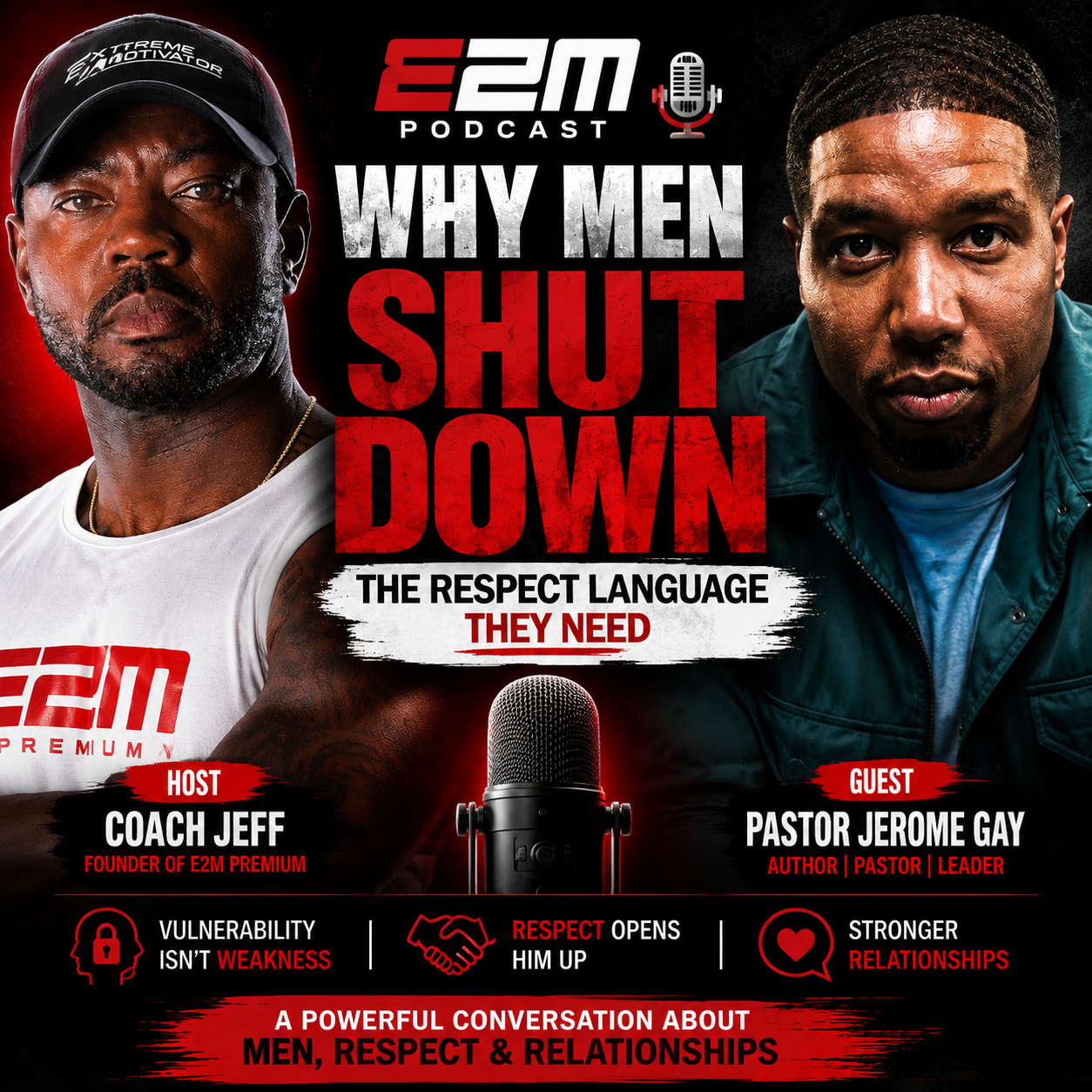
What's Going on, guys? Welcome back to the Eager to Motivate podcast. I got a special guest today. You know, I always kind of say special guest, but this is. This is a personal special guest to me. This is my brother, my friend, the leader of the flock, Pastor Jerome Day. What's going on, Pastor? How you doing, brother?
[00:00:32] Speaker B: I'm doing great, Jeff. Thanks a lot for allowing me to be on the podcast, man. You know, each one has changed my life, so I'm just grateful for this opportunity, man.
[00:00:41] Speaker A: Listen, you know, I. I want to. I want to touch on something. You know, I won't belabor this point, but, you know, Jerome is the kind of guy, man, the kind of pastor that, you know, he looks after the people, man.
In some. In some crazy times in my life, man, that brother was the guy who always checked on me, looked out for me, sent me the word to uplift my mind and my spirit. So, brother, publicly, I won't even hold you. I'm gonna publicly thank you, man, for always behind the scenes taking care of so many people, because I went to an event recently where a gentleman was. It was his 80th birthday, and all the people there were just giving him his flowers, talking about all the things that he's done for them and in their lives. And most of the time, adults, you. You never get to hear those things until you're passed away, and you don't get to hear them then because it's only your family and friends hearing about it, and you've. You've passed on and going on to glory. And so I want to be one of those people that speaks life, give the flowers to all of my people in real life. And you have been a good man to me, brother. So I thank you. So. Okay, now.
[00:01:45] Speaker B: Thank you so much, man. Feeling good.
[00:01:48] Speaker A: Oh, for sure. So let's jump right into this interview. So, you know, you. You. You are an author. You. You. You do your thing. You're a man of many talents, and you got a new book coming out, so I'll let you do a quick intro about your new book, tell us about it, and I'll tie it into, you know, my whole concept of. Of being mentally fit and physically fit, having your body and mind together, being ready to take on the obstacles of life, and being motivated to keep doing so. So. So, Pastor, kind of Jerome, tell us a little bit about your newest book, what you got coming out, you know, your thoughts behind that book, and just a little intro about it.
[00:02:24] Speaker B: Well, again, thanks, Jeff. Again, by God's Grace. This is my eighth book, and my eighth book is called how to how to Speak Man. Discovering the Respect Languages Men Need. And my premise is this, that men, we don't lack emotions. A lot of times we may lack the space to feel safe enough to share those emotions. And so men have been taught wrongly to associate emotional vulnerability with weakness. And consequently, this has a deleterious effect on us physically. Since I know you're all about physical health, there's a psychological term they use called alexithymia, and it's designed to capture this idea of the difficulty a lot of men have with communicating their emotions. And when we don't or we try to refuse the emotions that God has given us, it literally impacts our brains and our hearts and it shortens our lives. So I wanted to write the other side of that is oftentimes through years of counseling, I sit down with couples. I have to walk couples through things. And I hear a lot of times it's the woman saying, he just won't open up to me. And so I wanted to write a book that's going to give language to men so men will be able to communicate what they feel and what they need. And then women will be able to navigate what their man needs so that he'll feel safe to be vulnerable and open up. Because men not opening up is actually contributing to early death, suicide, relational unhealth, and broken relationships. I wanted to step into this relationship space and say that men have a language, and that language is respect, man.
[00:04:02] Speaker A: I love it, man. That's.
I'm super excited about all the books you've published. You've been doing your thing for quite a while. My brother, quite the accomplished author. Before I dive a little bit more into the book, though, I do want to hit one thing, because we have a lot of our E2 and families going to be watching this and that kind of stuff. And one thing I've noticed about you is just how you shared your health and wellness journey not just with your E2M fam, but also with your flock and, you know, and your friends. You've been a motivational guy when it comes to your own personal health and wellness journey. So how has. How has taking care of yourself helped you become a better father, a better husband, a better pastor, a better author.
How has your health and wellness journey helped you in those areas?
[00:04:52] Speaker B: Yeah, I'm all about the. The biblical term we use is discipleship. Right? Discipleship is what Jesus told us to do, go and make disciples. But. But discipleship is holistic. It's it's mine, it's emotions, it's soul, it's will and its body. And so the Bible tells us that the. The body is a temple of the Holy Spirit. And so we are called to steward these temples. Well, so several years ago, I came up. I came part of an E2M. I was 222 pounds, still preaching, but definitely a little more puffy in the face. Back then,
[00:05:28] Speaker A: everybody in the group thought he was Michael B. Jordan. I was like, I was puffy.
[00:05:32] Speaker B: I was puffy B. Jordan when I started.
But after One round of E2M, Jeff, you know, I lost 34 pounds. I lost 34 pounds. My first round of E2M. We were doing the team competition thing there. My team, we won.
Dwayne, who's on staff now, he was one of my coaches. And so it was just a great journey. And that physical journey, it led to discipline in so many other areas. And so, you know, pastors, we. We should obviously not just pastor everyone. We need to be in shape. And this, this is one of the ways I can shepherd my flock well, is doing all I can on my end to take care of my body.
[00:06:12] Speaker A: I know. And, you know, this, this wasn't a. A question on my list of questions, but I know that that is a touchy subject, especially in our community when we talk about, you know, leaders being healthy.
[00:06:27] Speaker B: Yeah.
[00:06:27] Speaker A: And, you know, I'm a huge advocate of not judging anybody. You know, that's not my role. That's not my place. But I want to encourage. I want to encourage because from the, from the leadership standpoint, in a. In a difficult world where it's hard to push away from the snacks to cakes, pies and cookies and make time for yourself, especially as a leader because you're so busy, you got so much going on, what would you say to some of the. Because we have lots of pastors, lots of people in clergy that watch or are members or people that I train.
What would you share to them about how you felt before as a leader and after?
Because you are in great shape now, my brother, and I'm proud of you. I applaud you. So how do you feel now, personally, as a leader, from your health and wellness journey, from standing in front of your, you know, your congregation before, when you weren't as healthy as you should be, and now that you're, you know, you're. You're a very healthy man. What. What felt different or what feels different now?
[00:07:28] Speaker B: Yeah. Inner energy becoming just more energetic. And which as comes out when it's time to preach. We're at a point we've grown by God's grace. And I'm doing three services.
So three services and not being healthy is not a good formula. But thank God I'm in much better, better shape. Clarity. Physical focus leads to mental focus. And so my, my study time, what we call exegesis, me digging into the word to prepare to go before God's people and share the word. I have that focus. Just sharpness of mind. Because as a, as the lead and founding pastor of a church of 1400 plus people, you know, I'm constantly making decisions and constantly having to pivot and adapt. And so physical, physical health contributes to all of that.
Then of course, just ambition. You know, you don't, I don't get to book number eight to be able to finish this book, how to Speak man, without, you know, that focus, that clarity and that discipline. And so working out gives you that discipline to now it's a habit. It is a part of my life that I'm not going a whole week not working out. I'm working out at least four times. Four days out of a seven day week.
[00:08:37] Speaker A: I like it, man. And it shows, man. So if you, somebody said that. Mike, Michael,
[00:08:45] Speaker B: you're gonna have, you're gonna have. You had a woman killing me in the comments, man. I never said I look like him. All right, ladies. And Jeff said it. I didn't say it.
[00:08:52] Speaker A: Hey, hey, bro, at least you look close. Like Michael B. Jordan to me.
I was like Will Smith one time. I was like, I don't know where you get that one from. Big dog number love. Hey, big, big Willie's my guy. But hey, so, so now let's, let's jump into the actual book and really dig into that. At one point in my life, I was super excited about wanting to write a relationship book because I was a single man for 12 years.
And during that 12 years, I saw a lot. I got to experience a lot and see a lot. And I felt like there was so many things that people just weren't seeing in relationships. The major thing was communication. They weren't understanding how to speak to each other, how to talk to each other. So from a pastor standpoint, you touched on this a little bit in your intro, but you, you counsel couples, so you get to see a ton of relationships gone, gone awry or struggling or needing help. So what, what, what specifically made you get inspired? Want to write this book?
[00:09:51] Speaker B: Yeah. So, you know, a lot of times inspiration can come from a burden.
[00:09:56] Speaker A: Yeah.
[00:09:57] Speaker B: And, and on this side. You know, Jeff, as a pastor, I marry and I bury. I do the baby dedication, and unfortunately, I counsel people through divorce. Right? And so I'm see.
And one of the things I kept seeing in relationships in pre and post marital counseling was a lack of understanding. The Bible says this, that the husband should love his wife as Christ loved the church. And it says that the wife should respect. And so one of the things I saw men struggling with was this, that respect is love to men. And that when a man feels disrespected, it permeates his body and it affects how he sees the woman in his life.
And so I wanted to help men say, well, brothers, the same way we say we don't want her to think we can read her mind when we don't express internally what disrespect is doing to us. Because sometimes her disrespect may be unintentional. We can develop something in our hearts. And here's the journey it takes that breaks communication. In particular, because this book is primarily to men, but it's for women as well, but specifically for men. When you feel disrespected, right? Whether it's intentional or unintentional, the first thing it does is it begins. If you don't deal with it, it festers. When it festers is playing in your mind. Like, why would she say that? How could she do this? Does she not think I'm a man? Does she think I'm weak? When it festers a long time, it then ferments.
Fermentation. Fermentation is bitterness. So now you're looking at her only through the lens of the disrespect that you let fester. It goes from festering to fermentation. Then here's the third fragment. Fragment is the break to when you begin to associate peace outside of the presence of your woman. And nobody wins when that happens. And so, again, I'm trying to help men, like, hey, we gotta talk. But then also, I do have a chapter called the Unsafe Woman, chapter four. Because sometimes, again, not all. Some women can contribute to why their man won't open up.
[00:11:55] Speaker A: Man, you know, I always attribute it to, it's my easy way out, Pastor. I'll be transparent with the people.
My easy way out of having some emotional unavailability or not showing a lot of emotion is I was in the military for 21 years. I had to be a leader. I had to be up front. Can't show fear. Can't show worry. Can't show sadness. You got to be a leader. And so from. From that mindset that I've carried, I'm an even keel kind of guy through all situations in life, good and bad. And that's something that, you know, I talk to my spouse about a lot, because the same way I don't show sadness at a deep level, I don't show happiness at a deep level. I'm kind of. And I remember this in my father. I remember my father. I never saw him get, like, super happy about anything. Like, ecstatic, like, joyful. The term. If you say the word this person is joyful. Like, what do you think about when you say that? I never saw those emotions in my father. And when I hear the term this person is depressed, I never saw that in him either. And so the same can be said about me. I'm always kind of right in the middle. You never see me. Great things happen. I get excited, but I don't show emotion about being excited. And bad things happen. Really bad things happen. People don't even know about, but I don't show sadness. So why do you think this is so common in men? I used to think that it was behind the military thing. And I'm a military man. I'm a soldier. I got to be a leader. I got to be a. A warrior. I got to push forward. But I'm noticing that that's it's not just military men. I feel like it's men in general. So why do you feel like men? Men. Men don't feel safe or don't feel comfortable expressing emotions. High levels of joy or low levels of sadness.
[00:13:46] Speaker B: Well, so two things. One, I start the book. The intro was called Shaq Said it, and men approved this message. Shaq went on a podcast, and he went viral for saying, I'm paraphrasing. He said, open up to a woman never, because the moment you do, they're going to throw it back in your face. And so the first reason, Jeff, is we've tried vulnerability, but all it takes is one time for a man for his vulnerability to be used against him. And he says, I'm never being vulnerable again.
And so in the military, and I grew up a military brat, My dad was in the military. We lived in Kansas, so I know about rations. Right?
[00:14:23] Speaker A: Yeah. Yeah. Oh, yeah.
[00:14:24] Speaker B: What ends up happening? So, because we. We get. We get hurt one, maybe two times now, we only ration some of us, parts of our hearts with people, and we're constantly trying to test and see. And so. So some of us, our vulnerability was against us. And we just said, I'm never going to put myself in that situation again. Again, though, that is another form of bondage because God has created all of us with emotions in particular. Emotion. Disrespect is an emotion. But the second reason, Jeff, and this is they're both equally as. As bad for us is we've been taught that, like, we hear man up, toughen up, show up. What show up can be sound good, but it can be bad. But all of these words have been taught only from the tough side, not from the tender side. And I like to tell men, because the Bible says that God is a warrior, God is a lion, but he. He's also presented as the lamb. And so we need to be able to flow between both. It doesn't mean me being vulnerable, doesn't mean I'm any. I can still bench press. I can still do it, but that's not what makes me a man. What makes me a man is that I'm both. I can be tender and I can be tough. And I have the maturity to know when each.
When one is needed. And so we've been taught wrong, Jeff. We've been taught to be emotional is to be weak, to communicate those motions. Weak. But actually, if you think about it, it takes strength to communicate what's happening inside of you. So it's not. It doesn't make you weak at all.
[00:15:52] Speaker A: Man, you hit on that strength versus tenderness thing. And that brings me.
Again, this is. I may go off my script a little bit because this is.
Yeah, so. So. So my, My. My thoughts that came to mind when you said tenderness versus strength. Right.
There's a poem in the movie called Antoine Fisher. Right, that movie, Antoine Fisher, older movie, been out for a long time.
One of the. The main character in there, he talks about a poem. He says a poem, you know, about who will cry for the little boy.
And so I think about young men and how the. The hiding of emotions start really young. They're trained. Men are trained as boys to.
As young girls are. Are encouraged to express their emotions. Young boys are encouraged to be tough.
[00:16:48] Speaker B: Yeah.
[00:16:49] Speaker A: So for me, in my life, I can say this is 100% true. I was always encouraged to be tough. And I would probably say, you know, this is giving myself some credit. I've been able to live through things that will crush most people. Combat, business things, all kinds of things that most people. I've watched and witnessed with my own two eyes. Buckle, buckle the knees, lay on the ground and cry. And, you know, I'm thankful for the toughness that I've been. Been given in life to be able to withstand those things.
But there is a. There is a little boy, per se, inside me that always wonders who's going to cry for me? Who.
[00:17:29] Speaker B: Who.
[00:17:30] Speaker A: Who is going to be soft for me. And now I have a spouse that is that way. But all through my. My life until then, it was always, nobody's going to cry for me. So I got to toughen up. I got to pick myself up. I gotta keep moving. I gotta be strong. And so a lot of parents have young boys.
How would you encourage them or tell them how they can encourage their young men to be strong, but also, it's okay to express your feelings?
[00:18:09] Speaker B: Yeah, great question, Jeff. Let's first deal with that premise, right? Connected to the poem from Antoine Fisher. And I remember that last scene with that big dinner table, that feast, and the love he felt. And so the premise you said is, who's going to cry for me? Well, here's the challenge for us as men.
How will they know if we never show tears?
See, so. So some. Sometimes, you know, it's like, we won't know who will until we let them know that there are kinks in this armor. We're not Superman. We have emotions. We have failures.
We miss the mark sometimes. And so I think that's the first thing is changing our premise to say, hey, I'm not gonna know who genuinely cares and who's willing and if I'm not willing to put myself out there. And your second part is, I have a son. I have a son, and I was taught the same way, Jeff, don't cry. Don't show emotion. Toughen up. And what that led to is that led to constant paranoia and constant competition because I felt like I entered in the room in a negative and I had to work my way to zero.
Right? And so you're constantly proving yourself. So I just learned, like, you know what? I gotta be who I am. Emotions are a part of my humanity. So I started early with my son's son. It's okay to cry.
It's okay to feel. You can cry. And I'm still gonna hold you accountable to make sure you handle your responsibilities. You're gonna be tender and tough, and you're gonna know how to vacillate between the two. And I'm gonna teach you the discernment of that. Hey, it's okay if I lose someone. Why do I have to not cry at the funeral? No, I love that person, and I'm sad that they're gone. And so it's okay. Grief. There's an entire book in the Bible called Lamentations because lament, lament is a part of the human experience. And so I think we just have to teach our boys in particular, hey, man, it's okay to cry and not think that letting them cry is somehow going to make them irresponsible. We can still hold them accountable and teach them responsibility.
[00:20:08] Speaker A: No, man, that's as deep, man. You just hit on something. Because that's a reminder for me that I still got work to do. I've lost a lot of people in my life and I've been so tough about making sure that everybody else is good, that all the logistic things are correct.
I go into leadership mode when it's a time for me to mourn as well. And so there's a lot of, a lot of mourning that I haven't done for big loss in my life because of the simple part that you just said you could be strong, you can still get to business and make things happen, but you can also show your emotion as well. So. No, that's deep.
[00:20:46] Speaker B: Yeah, yeah.
[00:20:47] Speaker A: I'm gonna jump into another aspect you mentioned earlier, which I, I, I've been talking about this for years, man. I just don't, I don't understand it sometimes because sometimes a person, when they are looking for a partner, they don't think long term.
[00:21:06] Speaker B: Yeah.
[00:21:06] Speaker A: And the person that you find to be cool and exciting today is a person you don't respect in the future.
And if you don't respect that person in the future, that's going to be, that's going to be the, the, the almost like the, the catalyst for poor communication. Because if you're disrespecting that man, you're not able to respect that man. He's going to have a hard time opening up to you because he feels like you're going to hold those things that he opens up to you against him. And so, so I, I, I am definitely curious about the, the, the con, the concept you talk about of respect and how, you know, a woman or a partner could put pressure on that man without the respect going along with it. And for a man, if there's pressure, but no respect, pressure and disrespect, you're going to have a hard time getting that man to open up. So can you, can you share a little bit more about your focus on respect?
[00:22:07] Speaker B: Absolutely. And so I'm, I'm sure a lot of the listeners and viewers are going to be familiar with the five love languages written by Gary Chapman. So people are familiar, you know, physical touch, words of affirmation, quality time, and so on. But so what I did with this book is I came up with five respect languages, and so that men have five respect languages. And so I'll just address one of them in regards to your question. One of the respect languages is space.
That men need space. Now, a lot of times in a relationship, the woman interprets space as him not wanting to be around her. She interprets space as rejection. And because she interprets space as rejection, she doesn't give that to him. Now he feels disrespected. And so he's physically present but emotionally absent. So he shut down because she did not give him the respect language of space. So in the book, I explained, I explained how men need to communicate space. Cause again, some women have.
It can break up insecurities because the last dude took that space to go see a side piece, right?
So she has some legitimate concerns. So I want to say, hey, hey, here's how you can communicate. Sometimes I need space so I can get my thoughts together so that we can finish this conversation. So if you give me the respect language of space, I'll actually want to be more vulnerable with you.
[00:23:34] Speaker A: But.
[00:23:34] Speaker B: But I need you to respect me enough to give me this time. So what I tell the men to do is, hey, you gotta give her that commitment that you're gonna come back and not just leave this issue unresolved and then let her know, here's why I need this space, and I need you to give me some time because you can process. You know, everyone in a relationship isn't. Isn't the same. You might be able to process right now and talk. I need to go for a walk, think about it, get my thoughts together, and then we can finish this major decision we need to make, right? And so. Cause men, we don't want to take Ls. And so sometimes giving me the respect language of space will actually deepen our connection.
But when you, when the woman responds from her insecurity, she now made it about herself. And now the man, he'll show up, but he won't open up. And so that's one example where you know, the respect language of space. And again, there are five. And I, I break all five down in detail in the book.
[00:24:30] Speaker A: No, man, I love it, man. I mean, I think you, you, you, you hit on something and, and I'm not gonna be that guy. A lot of podcast people do, a lot of them, they, if they just did this right? And if they do that right. And I would do this right. Yeah, it's a lot of finger pointing. So as men, what do. What do. What are we responsible for in this scenario? What, what do. What can we work on so we can allow our partners to better communicate with us? What can we do? What's our responsibility?
[00:24:59] Speaker B: Yeah, we. There's a chapter called process your pain. Right. And so that's. That's chapter three. So processing our pain. I tell couples this all the time, Jeff. I say your spouse's family of origin issues may not be your fault, but they are your responsibility.
Because you two just made a covenant, and so you are now walking through life. That means I get the total package, flaws and all.
So both of us are bringing our strengths together, but we're also bringing our flaws together. And so I think for men, for men, I define a man. And men, there are four foundational elements to what it means to be a man. Number one is to invest eternally. That's a relationship with God. Number two is to reject passivity. That means we're not operating in fear. We may feel fear, but we don't give into it. Number three is to accept responsibility. And number four is to lead courageously. I'll deal with the fourth one. We can lead courageously by letting them know what we feel. Right. A lot of times. Tell me if you said these two words, Jeff, by now.
I'm 47. I've said by now. I should be making this much by now. The church should be here by now. Someone say, my business should be here. A lot of men, weird. Those two words can cause depression because we're thinking about by now what we're not doing as opposed to by now. Look at what God has done. And so I think we can begin to share. You know, my by nows are making me just feel like a failure in life. By now I should be making this by now. We should be here by now. I should live here. By now. I would have traveled here. And when those by nows aren't fulfilled, we end up processing destructively through the bottle, through abuse, through different ways. And so for us, we gotta own how we have processed painfully or destructively, and how we can now shift and process purposefully and constructively to be the men that God has called us to be.
[00:26:59] Speaker A: Man, I love it now. I'm a take action kind of guy. Yeah, I like people to listen and absorb things, but I also like for them to go out and have an action plan. Go out and do it. So for those, those couples Listening, you know, husband or wife, you know, one side maybe listening.
[00:27:15] Speaker B: Yeah.
[00:27:15] Speaker A: What's some actions that. What's. What's one thing that a man can do right now, today, and a woman can do to work on that communication gap, to work on allowing that man to speak more about his feelings, to work on that better communication through allowing the open, safe opportunity to exchange feelings and emotions. What's one thing that that man and that woman can do starting today?
[00:27:38] Speaker B: Well, obviously, it takes intentionality. So one thing and. And obviously, I notice, you know, I would say obviously with the book, chapter three is processing your pain.
And in chapter three, Jeff, I talk about six types of communicators.
And there's the hinter who uses body language, but they don't get to the point. There's the hider who runs away from confrontation. There's the helper who's always correcting you. There's the herder who verbally assaults you. There's the hoper who just hopes that the problem will go away. But the number six is the healer.
What you can do is begin to examine what's going on.
[00:28:15] Speaker A: Yeah.
[00:28:16] Speaker B: And then move towards healing conversation. At the end of each chapter, I have what I call respect reflection questions. And so the way this is designed is a man can process this himself, but if you're in a relationship, you need a copy, she needs a copy. Because you're going to process it differently and then come together and talk.
You won't get the fruit of anything if you don't take the intentionality to put in the steps. I don't lose my 34 pounds if I don't get that meal plan. If I don't do my gallon of water, if I'm not doing the things that you. The tools you gave me about, what, four years ago now, I'm still seeing the fruit. So I think that's what I would direct them to do. If nothing else, go through chapter three. But again, these. All of them are going to benefit you. But do that and take intentionality.
[00:29:03] Speaker A: I love it. Now, you know, I want. I want everybody that watches to go out and buy this book. But what I. What I want you to kind of sew in them as we start to wrap this up is.
[00:29:12] Speaker B: Yeah.
[00:29:12] Speaker A: When you were putting this book together, when you were in your study, from getting your notes together outlining the chapters, getting everything lined up, what did you want the reader to walk away with? What was the takeaway? What was the big aha moment that you wanted each reader to have when they walk away? You Know from reading your book.
[00:29:33] Speaker B: Yeah, I want men to be able to communicate. We have to get better as men, communicating our expectations, our needs, but then also our hurts. So I want men to be able to communicate. And on the female side, women are going to learn how to navigate a vulnerable man without further making him feel bad for being vulnerable. And that's why I presented it as men do have a language, how to speak man, hence the title, how to speak man. And then again, discovering these respect languages. So when men, we learn our language and we learn how to communicate it, it's going to end in emotional mastery, relational health, deeper communication, and true intimacy. And that's what I'm hoping for people, you know, when they get the book.
[00:30:22] Speaker A: So, you know, that was the end of my scripted questions. Now I got my, my time is getting, but I got one or two personal questions per se.
[00:30:31] Speaker B: Let's go.
[00:30:33] Speaker A: So over the years, right, I can tell you, Pastor, I've seen common problems in people that need to be healthy. I can, I can, I can have somebody give me a five minute consultation. I can tell them ways they can improve today. Because I've seen it. I've seen it thousands of times, the same way you've seen it a bunch of times.
So when you, when you, when you think about all the couples you've counseled, right? And I think people need to hear this because some of us can be arrogant. I'll say some of us can. Me too. Like, oh, no, I don't do that. I don't do that. That's not gonna be me. I don't do that.
What's, what's that thing that most people in your counseling sessions. What thing that they cannot understand about communication or what's a commonality? Because I think one of those, one of those things that I feel like some people may feel like, I'm listening, I hear you, I listen to him, I make it safe, but they're really not.
So what's a common theme you're kind of seeing when you counsel couples that, hey, this happens more than you think.
So don't be arrogant to think it's not you.
[00:31:47] Speaker B: Yeah, the one word, ownership. And here's what I mean.
The person always downplays their contribution to what's wrong. So let's say, let's say you're 25% responsible and your, your boyfriend, girlfriend, spouse is 75% responsible. I tell people this, you're 100% responsible for your 25%.
And so the sooner you have that shift and you own it to that degree now you're able to actually listen to what this person is saying about how you're making them feel and how you are. Even though it may be a lesser percentage, you are still contributing to the problem. So as long as we don't own our issue, you cannot improve something you refuse to acknowledge. And so when I can get each party to own their mess, then they can actually move towards healing.
[00:32:41] Speaker A: My last question for you, Pastor. My last one.
[00:32:44] Speaker B: Let's go.
[00:32:45] Speaker A: I was surprised, and this is one of the reasons why I wanted to write a book myself. But, man, you take action and you wrote eight of them.
But a lot of people have a hard time hearing here's a problem that we can fix. Instead of you're blaming me for something.
How would you encourage people to get out of that mindset of I'm being blamed for his feelings, I'm being blamed for this?
[00:33:11] Speaker B: Yeah.
[00:33:12] Speaker A: Here is a problem. It's simply a problem that we can solve together. How would you encourage people to get out of the. Get out of the blame game? Don't worry. Don't worry about. I'm blaming you for it. Let's fix it.
Who cares who's the blame? So how would you encourage. Especially when it comes to men and women, a lot of us, we don't like to be blamed. Like, it's not my fault. It ain't my fault. It's your fault.
[00:33:36] Speaker B: Yeah.
[00:33:36] Speaker A: How would you. How would you get them out of the blame game?
[00:33:39] Speaker B: Yeah. Obviously, tone matters. I think we have to look at. If we use an accusatory. Accusatory tone, it's going to put the person on defensive. So I, I encourage couple to use these five words that my counselor encouraged me over 20 years ago. You ready, Jeff?
[00:33:54] Speaker A: Yeah, man.
[00:33:56] Speaker B: Can I make a request?
[00:33:59] Speaker A: Wow.
[00:34:00] Speaker B: And so the way that looks like in a relationship is you say, hey, if you the man. Hey, babe, can I make a request?
Rather than. Rather than saying I love football more than you, how about you just let me know you want to spend time with me right now and you feel ignored because I'm watching the game.
That request now shifts from. Because she just blamed him and basically said he. She didn't put love and everything. She blew it up bigger than what it was.
But now him instead of matching her energy.
And now they're shouting because, no, I don't love. I love you. Don't you see this house?
Can I make a request, babe?
Can we work on getting to the root issue?
Because the issue is not the game. The issue is you want to spend some time with me. All right, so. And then obviously the wife can do the same thing. Can I make a request?
Instead of thinking I want to spend time with my girls more than I'll spend time with you, just let me know you would like for me not to go out with them tonight so that we can have a date. You see what I'm saying? So if we can learn that how we present stuff oftentimes is too hyperbolic and it puts the person we're involved with on the defensive. So we can just use those five words. If we can employ those five words, can I make a request and then make sure the request is specific, is realistic, it's attainable, and it's loving, then we can get out of the blame game.
[00:35:25] Speaker A: I love it. I wasn't supposed to have no more questions, but I do got one more.
Hey, listen, man, this is. I think this is a great topic, man. I want people to learn from this stuff. You know me. Yeah.
So this is something else, Pastor, I want you to know. And like, when we came in, I. I said it like. I gave you your flowers up front.
[00:35:45] Speaker B: Yeah. Thank you.
[00:35:47] Speaker A: If we've been married for a long time or we've had a partner, been with somebody for a long time, whether you're married to them or not, they become familiar to us.
[00:35:57] Speaker B: Yeah.
[00:35:58] Speaker A: And a lot of people don't understand that, you know, the more familiar you come with things, the less you appreciate them, because it's a constant thing. It's always there. It's there every day. So. Oh, that's. That's just my car. My car is always out there. I don't gotta wash it. But if I gave you a new car, if you're a brand new car, you make sure that new car was washed. But if it's your old car, it's just my car. And I drive around from A to B. I've had it for five years. I'm not going to clean the rims. But if I gave you that new dream car, you wouldn't let me step into your car. Your new car with dirty shoes. But it was your old car. Put some mud in there, too, when you put the shoes in there. And so how would you advise people to not get familiar with their partner? Because that's a part of it. Because I've seen so many people in my life and that they. They wouldn't do it for the old partner, but they'll do it for the new. For the new guy. They wouldn't get in shape for the old partner, but they'll get in shape to get the new partner. Well, why didn't you get in shape to keep the old partner? They'll listen to the new person, but they wouldn't listen to the old person. The familiarness sometimes, you know, is a big issue for men and women. How would you remind people to not be too familiar whether they've been married for 5, 10, 15, 20 years, so familiar with their partner that they stop appreciating what they have? Because other people can see it. Other people can see the goodness in your husband and your wife. You got to see it too.
[00:37:29] Speaker B: Yeah. One of the things I always encourage couples to do, I say this, and I've been married 25 years and counting, praise God. Right is here it is. I say don't mistake function for health.
And what I mean by that is you could have a good routine. She takes the kids to school, I pick them up, we go on vacation. During this time, we celebrate anniversaries, birthdays, function.
Function does not equal health.
Health is determined by intentionality on checking in, not just on what you're doing, but how we're doing. And so something my wife and I have done and this has been gold for us, we started this a little year four because year three was rough for us. I didn't think that we were going to make it to year five.
We needed someone to help us stay married. And so since then, every Friday we check in.
And what I mean is we, we check in. Babe, how are you doing? Not what you're doing. Yes, she, she's my wife stays at home. That's still, to me, a full time job in itself. Obviously, I'm a lead pastor, I'm an author. But we check in on how we're doing.
Maybe something that, that offended them early in the week. Let's deal with it so that doesn't fester, ferment and fragment that I talked about earlier. So I think you have to be intentional about that. She can confront me. Hey, I just don't you. You've been rolling with this book. I'm not feeling as pursued. She has the latitude to tell me that so that I can make it, hey, let, let me schedule a couple's massage so we can get this time together. So I think couples don't address those things. They're not carving out time. They have function, but they don't have health. And so you need both. We need to function because things got to get done. But we need to be intentional about checking on the mental, emotional, spiritual, and physical health of this relationship. And again, that's. That's what I'm encouraging people to do in the book.
[00:39:22] Speaker A: Man, I love it. Now, y' all know I could ask 10 more questions, but I ain't gonna do the good pastor like that. So on the way out, pastor, first I want you to tell them where they can find you at for worship. That's the first thing. Tell them that right now.
[00:39:34] Speaker B: Yeah, yeah, yeah. So Vision Church, we're in Raleigh, North Carolina, North Raleigh, 5808 departure drive. We have services at 8:00am, 9:30am and 11:30am and all are welcome. We also stream, if you look up Vision Church RDU on YouTube, we stream our 9:30 and our 11:30 service.
[00:39:53] Speaker A: So if you're not in Raleigh, I don't want to see in the comments. Oh, well, I don't live there. You can watch the stream, you can watch them streaming, and of course, you can support the mission of what he's doing at Vision Church. And so the next thing I want you to talk about where they can find your books, because you got eight of them.
[00:40:09] Speaker B: So this, this is the one. How to Speak Man. Discovering the Respect Languages Men Need. It's available wherever books are sold, and so you can get it from Amazon, Barnes and Nobles, wherever. It's also in Kindle, as well as audible form, as well as some of my other books I've written on other topics as well. So all of them are available wherever books are sold. But this is the one right here. This is going to help your relationship, ladies. This will help you learn how to help your man open up. And men, this will help you explain to your lady what you need from her.
[00:40:44] Speaker A: How to Speak Man. I'll make sure I put that title in the caption. You know, you go right to Amazon, you see the COVID so don't, don't get the bootleg version.
I learned that about Amazon, Pastor. Sometimes you will take your. Take your title there and put another book in there. So, so look for the right one. But the last thing, the last thought I want to pass over to the good pastor, I want to allow you to. To say any kind of parting words that you want to share with any relationship or couple that's struggling. Like you said, somebody sold a good seed of. Of. Of good information into you and your spouse.
[00:41:20] Speaker B: Yeah.
[00:41:20] Speaker A: 20 years ago.
So what, what, what nugget would you leave with somebody who is like, you know, they've been struggling in their relationship, marriage has been on a rocky spot. Just. That's what I Want to leave them with.
[00:41:32] Speaker B: Yeah. For me, obviously, I know we have people of all walks of life and even some different phase, but I do want to share, just from my perspective as a. As a Christian, I believe. We believe that Jesus resurrected from the dead. That means that if he can defeat death, he can handle a marriage that's on the verge of divorce. Now, here's the thing, though.
It does take both of you to be committed in order to address the issues and don't hide them, and then be committed to working through. And if you are a believer in Christ, you have a savior who defeated the grave. He can fix this. So I would encourage you not to give up hope, to do all you can on your end. Even Again, if it's 25%, you're 100% responsible for your 25%. And then continue to love and pray for that person and work through it. Secondly, be committed to honest communication.
Don't have to communicate the truth in love. Doesn't mean that you're soft. It means that you recognize that presentation matters. And then intentionality. You have to put in the work. And so I encourage you guys to put in the work. And if both of you put in the work, to learning each other and wanting to understand each other, not just be understood, healing will take place.
And what seems broken can then be reconciled. And so I just want to leave you with that hope and know that it is possible. Crystal and I almost didn't make it, but Here we are 25 years and counting, so it's possible.
[00:42:58] Speaker A: I love it.
Family, I appreciate you watching today.
I. Whenever I go, if you see a podcast that goes longer than 30 minutes, that means that it was a good one to watch because I wanted to keep.
So. So. So in the future, if you ever see me do a long one, I got Dwayne right here in the corner. If you ever see me and Dwayne do a long one.
Don't. Don't skip the long ones. The long ones are the ones that I got excited about and wanted to keep talking. And I will tell you, you know, Pastor Jerome, you know, I can only speak for my personal experiences in life. Man, you are a man that walks the walk. You don't just talk to talk. You walk the walk.
And so, you know, I want to leave the. The E2M fam and our viewers with this.
Take a look at what this brother's doing. Take a look at what the good pastor is doing, because he's doing good things, not only, you know, in his author life, but in his community and. And what he does for others and how he shepherds his flock. So thank you all for tuning in today. Pastor Jerome, my brother, I appreciate you, man. Never, never will forget what you've done for me. And go out and buy that book.
I got a couple of copies on the way. Coming to my house right now.
[00:44:06] Speaker B: Yeah, for couple singles. It's for everybody.
[00:44:09] Speaker A: All right, Y' all have a good one. Take care.